
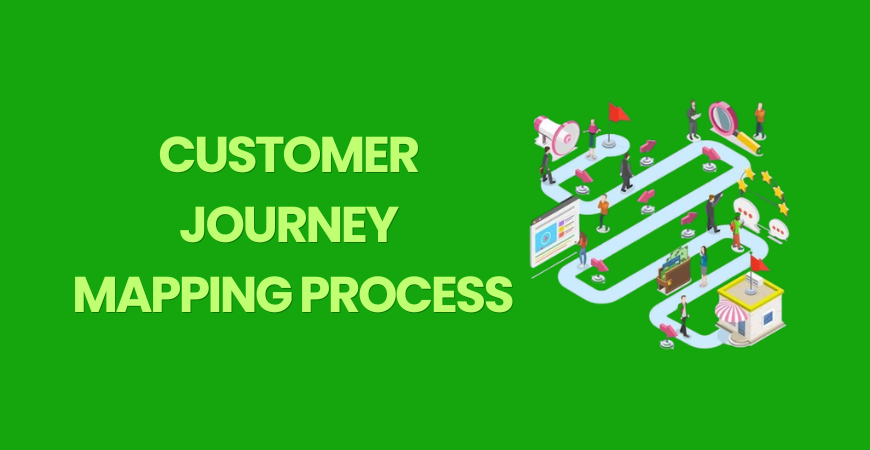
The customer journey mapping process is a key foundation of modern marketing because it helps businesses understand how users actually behave across different touchpoints. Instead of assuming a straight path from awareness to purchase, it focuses on real interactions, emotions, and decisions that happen before a user converts or drops off. It gives a clearer view of how people move between search engines, websites, ads, and reviews.
Most businesses struggle with conversions not because their offer is weak, but because they don’t understand the full user experience. A structured journey mapping approach turns scattered behavioral data into a clear visual flow that teams can analyze and improve. This guide breaks down the process step by step in a simple way so beginners can apply it without confusion.
What is Customer Journey Mapping Process?
The customer journey mapping process is a structured method of visualizing every interaction a customer has with a brand—from the first awareness stage to post-purchase behavior. It is not about funnels or marketing sequences but about understanding real human behavior.
Unlike traditional models, this mapping process does not assume that users follow a fixed path. Instead, it captures how users move unpredictably between channels like search engines, social media, websites, emails, reviews, and even offline interactions.
A key difference is that this journey mapping process focuses on:
- User emotions at each touchpoint
- Behavioral patterns instead of assumptions
- Real-time decision-making triggers
- Friction points that block conversions
This makes it far more insightful than traditional marketing models.
For example, before designing a funnel, marketers often use insights from marketing funnels to understand how structured conversion systems differ from real user journeys.
Why This Journey Mapping Process Matters
The customer journey mapping process is essential because modern users don’t follow straight paths anymore. A typical buyer might:
- Discover a brand on Instagram
- Search reviews on Google
- Visit the website multiple times
- Compare competitors
- Leave without buying
- Return later through a retargeting ad
Without mapping this journey, businesses often misinterpret user behavior and optimize the wrong touchpoints.
Here are key reasons why this mapping process is critical:
1. It reveals hidden friction points
Users often drop off due to confusion, not lack of interest. The mapping process identifies exactly where this happens.
2. It improves marketing decisions
Instead of guessing, teams rely on actual user data and behavior insights.
3. It aligns teams across marketing and UX
Designers, marketers, and product teams can all work from the same customer understanding.
4. It increases conversion efficiency
When you fix real journey problems, conversions improve naturally without aggressive selling.
Modern strategies like AI marketing automation are also being used to enhance personalization in customer journeys, but the foundation still remains understanding the journey itself.
Step-by-Step Customer Journey Mapping Process
Now let’s break down the complete mapping process into actionable steps.
Step 1: Define the Customer Segment Clearly
The first step in this journey mapping process is identifying who you are mapping the journey for. Many beginners make the mistake of trying to map “all customers” at once, which leads to confusion.
Instead, focus on one specific user type:
- First-time website visitor
- Returning researcher
- Price-sensitive buyer
- Mobile-first user
Each of these users behaves differently, so their journeys must be mapped separately.
A well-defined persona makes this mapping process more accurate and actionable.
Step 2: Identify All Touchpoints
The second step is listing every possible interaction point between the customer and the brand.
These include:
- Google search results
- Social media ads
- Website pages
- Blog content
- Reviews and testimonials
- WhatsApp or chat support
- Email communication
At this stage, you should not structure anything. Just collect raw data.
Here is a simple example table:
| Touchpoint | User Action | Possible Emotion |
| Google Search | Clicks result | Curiosity |
| Website Homepage | Scrolls | Interest or confusion |
| Product Page | Compares details | Evaluation |
| Checkout Page | Abandons cart | Hesitation |
This raw mapping is the backbone of the customer journey mapping process.
Step 3: Study User Behavior Patterns
At this stage, the focus shifts from touchpoints to behavior.
You need to understand:
- Where users click
- How far they scroll
- Where they exit
- What they ignore
This is where behavioral tools become important. Insights from user behavior analysis help marketers understand real interaction patterns instead of assumptions.
For example:
If users consistently drop off halfway through a page, the issue may not be the offer but the content structure or clarity.
Understanding behavior is one of the most powerful parts of this mapping process because it exposes hidden friction.
Step 4: Map Emotional States of Users
One of the most overlooked parts of the journey mapping process is emotion tracking.
At every stage, users feel something:
- Confused
- Curious
- Skeptical
- Confident
- Frustrated
- Ready to act
Emotions often decide whether a user continues or leaves.
For example:
- A lack of trust signals may create hesitation
- Too much information may create confusion
- Clear benefits may increase confidence
Mapping emotions makes this process more human-centered rather than data-only.
Step 5: Identify Friction Points and Drop-offs
Once behavior and emotions are mapped, the next step is identifying friction.
Common friction points include:
- Slow-loading pages
- Confusing navigation
- Lack of trust signals
- Too many steps in forms
- Unclear pricing or offers
These issues are often the real reason users do not convert.
This stage is critical because it directly highlights improvement opportunities.
Step 6: Connect Touchpoints into a Journey Flow
Now comes structuring. In this stage, you connect all insights into a visual or logical flow.
However, unlike funnels, this is NOT linear.
A real journey may look like:
- Search → Website → Exit → Return via ad → Blog → Review site → Purchase
This non-linear structure is what makes the journey mapping process more realistic than traditional funnel models.
Step 7: Validate with Data and Metrics
Once the journey is mapped, it must be validated with data.
Key metrics include:
- Drop-off rates
- Bounce rates
- Session duration
- Conversion rates
Using a conversion tracking guide helps ensure that every insight from the journey mapping process is backed by measurable data.
Without validation, journey maps remain assumptions rather than actionable insights.
Step 8: Identify Optimization Opportunities
After validation, businesses can identify improvement areas such as:
- Improving landing page clarity
- Reducing friction in forms
- Strengthening trust signals
- Improving content structure
- Enhancing navigation experience
A key improvement area often comes from optimizing entry pages using landing page optimization, which directly influences early-stage user behavior.
Step 9: Build the Final Customer Journey Map
The final stage of the customer journey mapping process is creating a structured visual representation.
A complete journey map includes:
- Stages of interaction
- Touchpoints
- Emotions
- Pain points
- Opportunities
This can be created using simple tools like spreadsheets, diagrams, or visualization software.
Clarity is the goal, not complexity.

Common Mistakes
Many beginners fail the journey mapping process due to avoidable mistakes:
1. Treating it like a funnel
A journey is not strictly linear like a funnel, so this approach misses looping and revisit behavior. Customers often move back and forth between stages before making a decision.
2. Ignoring emotional data
Without emotions, the journey map becomes purely transactional and loses real insight. Emotional triggers like trust, doubt, and urgency strongly influence decisions.
3. Skipping real behavior analysis
Relying on assumptions instead of actual user data leads to inaccurate journey mapping. Tools like heatmaps and session recordings reveal what users actually do.
4. Overcomplicating the structure
Adding too many layers makes the journey map confusing and hard to use. A simple, clear structure is more actionable for marketing and UX teams.
5. Not updating the journey map
Customer behavior changes with time, trends, and platforms. An outdated map quickly becomes irrelevant and misleading.
Tools That Support Customer Journey Mapping
While the customer journey mapping process is primarily analytical, certain tools can help:
- Analytics platforms
- Heatmaps
- Session recording tools
- Survey tools
Some advanced systems even integrate AI, and concepts from AI marketing automation are starting to enhance how journeys are visualized dynamically.
However, tools should support understanding—not replace thinking.
Frequently Asked Questions
1. What is the customer journey mapping process?
It is the method of visualizing user interactions, emotions, and behaviors across all touchpoints.
2. Is the mapping process the same as a funnel?
No, funnels are linear business models, while the customer journey mapping process is based on real user behavior.
3. Why is customer journey mapping important?
It helps identify friction points and improve user experience and conversions.
4. Do small businesses need journey mapping?
Yes, even small websites benefit from understanding user behavior patterns.
5. How often should the journey map be updated?
It should be updated whenever user behavior or marketing channels change significantly.
Conclusion
The customer journey mapping process is not just a marketing exercise but a practical way to understand how real users interact with a brand across multiple touchpoints. Instead of relying on assumptions, it helps businesses identify friction points, emotional triggers, and behavior patterns that influence decisions. This shifts the focus from guessing to understanding, leading to better user experiences, stronger engagement, and improved long-term customer trust for businesses that apply it effectively.

