
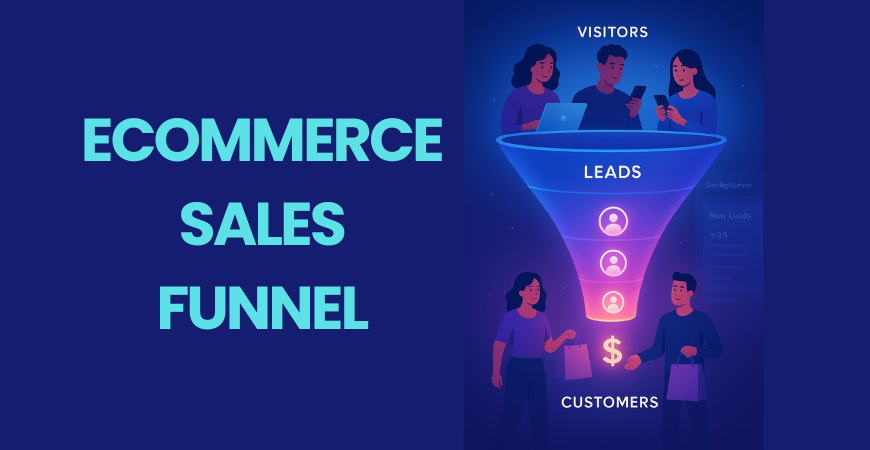
Ecommerce sales funnel is the missing piece for most beginners who struggle to turn website visitors into actual customers. This is where a clear ecommerce marketing approach becomes important, connecting traffic, engagement, and conversions into one structured system.
You might already be getting traffic from social media, SEO, or ads. People are visiting your store, browsing products, and even adding items to their cart. But when it comes to actual sales, things don’t move the way you expect.
That gap between visitors and buyers is not random. It follows a pattern, and that pattern is exactly what an ecommerce sales funnel helps you understand and fix.
Instead of guessing what’s going wrong, the funnel gives you a clear way to see where people lose interest, hesitate, or drop off. Once you understand this journey, improving your results becomes much more practical and less confusing.
What is an Ecommerce Sales Funnel?
An ecommerce sales funnel is the structured journey a potential customer goes through before making a purchase. It is not just a concept, it’s a real behavioral flow that every online buyer follows, whether you notice it or not.
At a basic level, the funnel has four core stages:
- Awareness
- Interest
- Decision
- Action
Some businesses also extend it to include retention, which focuses on repeat purchases.
The reason it’s called a “funnel” is simple. At the top, many people enter. But as they move forward, fewer continue to the next stage. Your goal is not to stop this natural drop, but to reduce unnecessary loss and guide more people toward conversion.
Why Understanding the Funnel Matters More Than Traffic
Many beginners believe that more traffic automatically leads to more sales. In reality, traffic alone doesn’t guarantee anything.
You could attract thousands of visitors but still face challenges in making sales if your funnel isn’t strong. On the other hand, even a smaller number of visitors can generate consistent sales if your funnel is structured properly.
This is why successful online stores don’t just focus on traffic. They focus on how visitors behave after they arrive.
For example, building organic traffic is a strong starting point because it brings users who are already searching for solutions. But unless your funnel guides them clearly, even the best traffic won’t convert.
The ecommerce sales funnel helps you connect traffic with results.
The Four Core Stages of an Ecommerce Sales Funnel
Let’s break down each stage in a way that makes practical sense for beginners.
1. Awareness Stage: Getting the Right People
This is where people first discover your store.
Common Problems:
- Wrong audience targeting
- Low-quality traffic
- No clear brand message
Many beginners try to get as much traffic as possible. But traffic without relevance is useless.
What Actually Works:
Instead of chasing numbers, focus on attracting the right audience.
You can start by building organic traffic through content, SEO, and problem-solving blogs. This helps bring people who are already interested in what you offer.
Key Tip:
Don’t ask, “How do I get more visitors?”
Ask, “Are the right people visiting my store?”
2. Interest Stage: Keeping Visitors Engaged
Once a visitor arrives at your website, you have only a few seconds to grab their attention.
Common Problems:
- High bounce rate
- Confusing layout
- No clear value
Visitors leave when they don’t understand:
- What you’re selling
- Why it matters
- Why they should trust you
What Actually Works:
- Clear headlines
- Simple product descriptions
- Visual storytelling
This is where your content funnel plays a huge role. Instead of pushing sales immediately, you guide users with helpful information, benefits, and use-cases.
Example:
Instead of just showing a product, show how it solves a problem.
3. Decision Stage: Building Trust
At this stage, users are interested but not fully convinced.
Common Problems:
- Lack of trust
- No social proof
- Unclear product value
People often hesitate due to the fear of making the wrong decision.
What Actually Works:
- Customer reviews
- Testimonials
- FAQs
- Clear product benefits
Studies indicate that more than 90% of consumers read reviews before making a purchase.
Key Insight:
You don’t need more traffic here.
You need more confidence signals.
4. Action Stage: Converting Visitors Into Customers
This is the last stage, where users actually make a purchase.
Common Problems:
- Complicated checkout
- Hidden costs
- Slow website
Even interested users drop off at this stage due to friction.
What Actually Works:
- Simplified checkout
- Transparent pricing
- Fast loading pages
Optimizing your landing pages can significantly improve conversions. Small changes like better CTAs, fewer form fields, and clear pricing can make a big difference.
The Often Ignored Stage: Retention
Most beginners stop after the sale.
That’s a mistake.
A strong ecommerce sales funnel doesn’t end at purchase; it continues.
Why Retention Matters:
- Cheaper than acquiring new customers
- Builds long-term business
- Increases lifetime value
What Actually Works:
- Follow-up emails
- Offers and discounts
- Personalized communication
Using email leads, you can stay connected with your customers and bring them back for repeat purchases.
Understanding Drop-Offs: Where Things Go Wrong
Every funnel experiences drop-offs. The essential part is to understand where and why they occur.
Here are three common real-world scenarios that help you identify issues quickly.
Scenario 1: High Traffic but Low Sales
What’s happening:
People are visiting but not buying.
Problem Stage:
Decision or Action
Fix:
- Improve trust (reviews, testimonials)
- Simplify checkout
Scenario 2: Low Traffic but Good Conversion
What’s happening:
People buy, but very few visit.
Problem Stage:
Awareness
Fix:
- Focus on SEO
- Increase content
- Work on increase traffic strategies
Scenario 3: Add-to-Cart but No Purchase
What’s happening:
Users show intent but drop off.
Problem Stage:
Action
Fix:
- Reduce checkout friction
- Show total cost upfront
- Add urgency
A Simple Ecommerce Sales Funnel Plan for Beginners
If you’re just starting, keep it simple and avoid unnecessary complications.
Follow this:
Step 1: Identify Your Weakest Stage
Find where users drop off the most.
Step 2: Fix One Problem at a Time
Don’t try to fix everything together.
Step 3: Improve User Experience
Focus on clarity, speed, and simplicity.
Step 4: Build Trust Gradually
Add reviews, testimonials, and helpful content.
Step 5: Track and Improve
Observe results and keep optimizing.

Key Metrics That Actually Matter
You don’t need to track dozens of numbers to understand your funnel. A few key metrics can give you enough insight.
| Funnel Stage | What to Track |
| Awareness | Website traffic |
| Interest | Bounce rate |
| Decision | Add-to-cart rate |
| Action | Conversion rate |
| Retention | Repeat purchase rate |
These metrics act as signals. They assist you identify the strengths and weaknesses of your funnel’s performance.
Common Mistakes Beginners Should Avoid
1. Focusing Only on Traffic
Traffic without conversion is meaningless.
2. Ignoring User Experience
A confusing website kills sales instantly.
3. Copying Competitors Blindly
What works for them may not work for you.
4. Trying Everything at Once
Too many changes = no clear results.
5. Not Understanding the Funnel
Without a funnel, marketing becomes guesswork.
Conclusion
An ecommerce sales funnel is not just a marketing concept, it’s a way of understanding how your business actually works.
Every visitor who lands on your website is part of a journey. Some will explore, some will hesitate, and some will buy. Your job is to guide them through each step with clarity and confidence.
Instead of chasing quick results, focus on building a system that consistently turns visitors into customers.
When you improve each stage of your funnel step by step, growth becomes predictable rather than accidental.
And that’s when your traffic finally starts converting into real business outcomes.
Frequently Asked Questions
1. What is the main purpose of an ecommerce sales funnel?
Its purpose is to guide potential customers from discovery to purchase by reducing confusion and improving decision-making at each stage.
2. How long does it take to see results from a funnel?
It depends on your traffic and current setup, but small improvements can start showing results within a few weeks.
3. Can beginners build an effective funnel?
Yes. By focusing on clarity, simplicity, and user experience, beginners can build a strong and effective funnel without advanced tools.
4. Do I require paid ads for a funnel to work?
No. While ads can accelerate traffic, a well-structured funnel can work effectively with organic methods as well.

