
The Short Answer
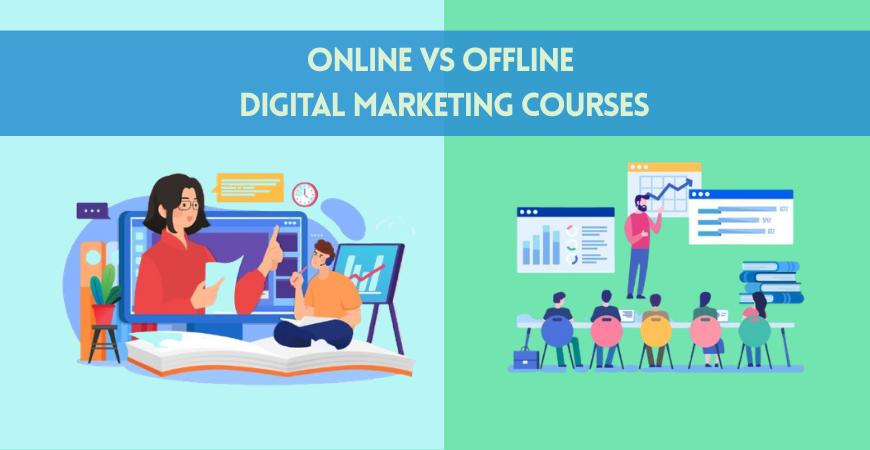
Online vs offline digital marketing courses differ mainly in flexibility, interaction, structure, and learning environment. Online courses suit learners who value convenience and flexible schedules, while offline courses offer face-to-face guidance and classroom structure. Neither is universally better; the right choice depends on your learning style, schedule, budget, and career goals.
Introduction
Choosing between online vs offline digital marketing courses can be difficult when both formats promise practical skills, certifications, and career opportunities. The real question is not simply which format is better, but which one can give you the learning experience and practical exposure you need.
This guide compares both formats across training quality, practical projects, tools, AI, fees, flexibility, instructor support, and career preparation. It also gives you a simple framework to decide which option fits your situation.
Online vs Offline Digital Marketing Courses: Key Differences
The biggest difference is the way learning is delivered. Online courses use digital platforms for live or recorded instruction, while offline courses provide classroom-based learning at a physical location. However, the delivery format alone does not determine the quality of training.
| Factor | Online Courses | Offline Courses |
| Flexibility | High | Moderate |
| Location | Learn from anywhere | Fixed location |
| Instructor interaction | Digital | Face-to-face |
| Networking | Primarily online | Easier in person |
| Schedule | Often flexible | Usually fixed |
| Commuting | None | Required |
| Recordings | Often available | Depends on institute |
| Practical learning | Depends on course | Depends on institute |
| Self-discipline | More important | Less important |
| Convenience | High | Moderate |
For example, a student who lives far from a training centre may benefit significantly from online learning. A beginner who struggles to study independently may prefer the structure of a classroom.
The important point is that course quality should be evaluated separately from delivery format. A poorly designed offline course will not become useful simply because it takes place in a classroom. Similarly, a well-structured online program can provide meaningful interaction and practical experience.
Which Is Better for Practical Digital Marketing Training?
Neither format automatically provides better practical training. Hands-on assignments, tool usage, projects, feedback, and instructor involvement matter more than whether the class takes place online or offline.
A practical program should allow learners to apply concepts instead of only watching lectures. For example, SEO training could involve keyword research, content optimisation, technical checks, and performance analysis. Google Ads training could involve campaign planning, keyword selection, ad creation, bidding concepts, and conversion tracking.
The same applies to social media marketing, content marketing, email marketing, analytics, and conversion optimisation. Good practical digital marketing training should make learners perform tasks, review their work, identify mistakes, and improve their approach.
What Practical Training Should Include
Look for courses that provide:
- Live assignments
- Tool-based exercises
- Realistic marketing projects
- Campaign analysis
- Instructor feedback
- Performance reporting
- Portfolio development
The format matters less when both options provide these elements. Before enrolling, ask whether you will actually work with marketing tools or simply watch demonstrations.

Online vs Offline Digital Marketing Course Fees
Course fees vary considerably between providers, so there is no universal price difference between online and offline learning. Curriculum depth, duration, faculty, projects, tools, internship opportunities, certification, and career support can all influence the total cost.
| Cost Factor | Online | Offline |
| Course fee | Varies | Varies |
| Travel expenses | Usually none | Possible |
| Time spent commuting | Minimal | Higher |
| Learning materials | Usually digital | Digital or physical |
| Flexibility | Usually higher | Usually lower |
| Overall value | Depends on offering | Depends on offering |
A lower fee does not automatically mean better value. Likewise, an expensive program is not necessarily better.
When comparing digital marketing course fees, calculate the complete value of the program. Check what is included in the fee, such as projects, tool access, assignments, internship opportunities, certification, mentoring, and career support.
What Should You Look for in a Digital Marketing Course?
A good digital marketing course should combine fundamental marketing knowledge with practical execution and current industry skills. The curriculum should also evolve as platforms, technologies, and consumer behaviour change.
Updated Course Curriculum
Start by reviewing the syllabus instead of relying on the course title. A comprehensive curriculum may cover SEO, PPC, social media marketing, content marketing, email marketing, analytics, ecommerce, conversion optimisation, and digital strategy.
The depth of each module matters too. A syllabus containing dozens of topics is not automatically better if every topic receives only a brief theoretical explanation. Reviewing the digital marketing course syllabus can help you understand whether the program matches your intended career path.
Practical Skills and Projects
Students should finish a course knowing how to perform basic marketing tasks, not just define them.
Important skills can include keyword research, content planning, campaign setup, audience targeting, analytics interpretation, social media planning, and conversion optimisation.
You can explore digital marketing skills in greater detail to understand which capabilities beginners should develop.
Projects are equally important because they give learners something concrete to practise and discuss during interviews. Useful projects might involve creating an SEO strategy, planning a paid advertising campaign, developing a content calendar, or analysing website performance.
A strong portfolio can demonstrate how you approach marketing problems rather than simply listing the courses you completed. This is why digital marketing projects can be particularly valuable for students and freshers.
AI and Modern Marketing Tools
AI has become an important part of modern marketing workflows, but an updated course should teach more than basic AI tool usage.
Learners should understand how AI can support:
- Content ideation
- Keyword and competitor research
- Data analysis
- Customer segmentation
- Workflow automation
- Content optimisation
- Campaign planning
At the same time, students need to develop judgement around accuracy, originality, brand voice, privacy, and strategic decision-making. AI should support marketing work rather than replace critical thinking.
Someone considering an AI digital marketing course should therefore examine whether AI is integrated into practical marketing activities or simply taught as a standalone topic.
Faculty and Instructor Support
Faculty interaction is another important difference between online and offline learning, but the quality of interaction matters more than the format.
Ask whether instructors provide assignment feedback, answer questions, explain real campaign examples, and help students correct mistakes. In an online course, this may happen through live sessions, discussion channels, mentoring, or individual feedback. In an offline classroom, it may happen directly during or after sessions.
Internship and Career Support
Internships can help students understand how marketing work operates in professional environments. However, the word “internship” alone does not tell you how valuable the experience will be.
Before enrolling, ask:
- What tasks will interns perform?
- Will they work on actual marketing activities?
- Is there supervision?
- Will their work be reviewed?
- Can they use completed work in a portfolio?
- What career support follows the training?
Placement assistance should also be understood carefully. Resume preparation, interview practice, job referrals, and employer connections are useful forms of support, but they should not automatically be interpreted as guaranteed employment.
Certification
A certificate can document that you completed a course, but it should complement practical ability rather than replace it.
Employers may want candidates to explain how they would approach a marketing problem, analyse data, use relevant tools, or discuss previous projects. Therefore, a strong combination is certification + practical skills + demonstrable work.

Online vs Offline: Which One Should You Choose?
The right format depends on your schedule, learning style, location, and need for instructor interaction. Use the following framework before choosing a course:
| Your Situation | Recommended Format |
| Need maximum flexibility | Online |
| Work full-time | Online |
| Live far from training centres | Online |
| Prefer self-directed learning | Online |
| Prefer face-to-face teaching | Offline |
| Need classroom structure | Offline |
| Value in-person networking | Offline |
| Learn through direct discussion | Offline |
| Want flexibility and classroom interaction | Hybrid |
Online learning can be a better fit if you have work or college commitments, need flexible schedules, or live far from a preferred institute. It also works well for learners who are comfortable with digital platforms and can maintain a consistent study routine. However, you need greater self-discipline to attend sessions, complete assignments, and practise regularly.
Offline learning can be more suitable if you prefer fixed schedules, face-to-face explanations, classroom discussions, and direct interaction with instructors and peers. The main trade-offs are commuting, location restrictions, and potentially less flexibility. Consider whether the classroom experience adds enough value to justify these limitations.
Hybrid learning combines online convenience with offline interaction. For example, learners may attend practical sessions in person while using online resources, recordings, or additional sessions for revision. It can be a useful middle ground for learners who want both flexibility and direct guidance.
How Academy of Digital Marketing (ADM) Fits These Criteria
Academy of Digital Marketing (ADM) can be evaluated using the same criteria discussed throughout this guide: curriculum relevance, practical learning, industry tools, AI-enabled workflows, projects, and career preparation.
For learners comparing digital marketing education options, these factors provide a more useful basis for evaluation than simply asking whether a program is online or offline. ADM’s learning approach places emphasis on connecting digital marketing concepts with practical skills, tools, projects, and professional preparation.
Learners researching a digital marketing course in Kolkata can use the same checklist to compare ADM with other options and determine whether the curriculum, training format, practical exposure, and career support match their individual goals.
Frequently Asked Questions
Between online vs offline digital marketing courses, which one is better?
Neither is universally better. Online suits learners seeking flexibility, while offline can suit those who prefer structure and face-to-face interaction.
Is an online digital marketing course worth it?
Yes, if it provides structured instruction, practical assignments, projects, tool exposure, feedback, and relevant career support.
Is offline training better for beginners?
It can be helpful for beginners who prefer classroom structure and direct guidance. However, course quality matters more than the delivery format.
Which format is better for working professionals?
Online training is often more convenient because professionals can learn without regular commuting. A flexible schedule can make it easier to balance work and education.
Can I learn SEO and Google Ads online?
Yes. SEO and Google Ads can be taught effectively online when learners receive practical assignments and opportunities to work with relevant tools.
Which format is better for getting a digital marketing job?
Neither format guarantees a job. Practical skills, projects, portfolio quality, tool familiarity, communication, and interview preparation are more important than whether training was online or offline.
Conclusion
Online vs offline digital marketing courses do not have one universal winner. Online learning offers flexibility, convenience, and location independence, while offline learning provides classroom structure, direct interaction, and easier in-person networking. The better option is ultimately the one that matches your learning style and provides an updated curriculum, practical projects, industry tools, AI exposure, instructor support, and realistic career preparation.

