
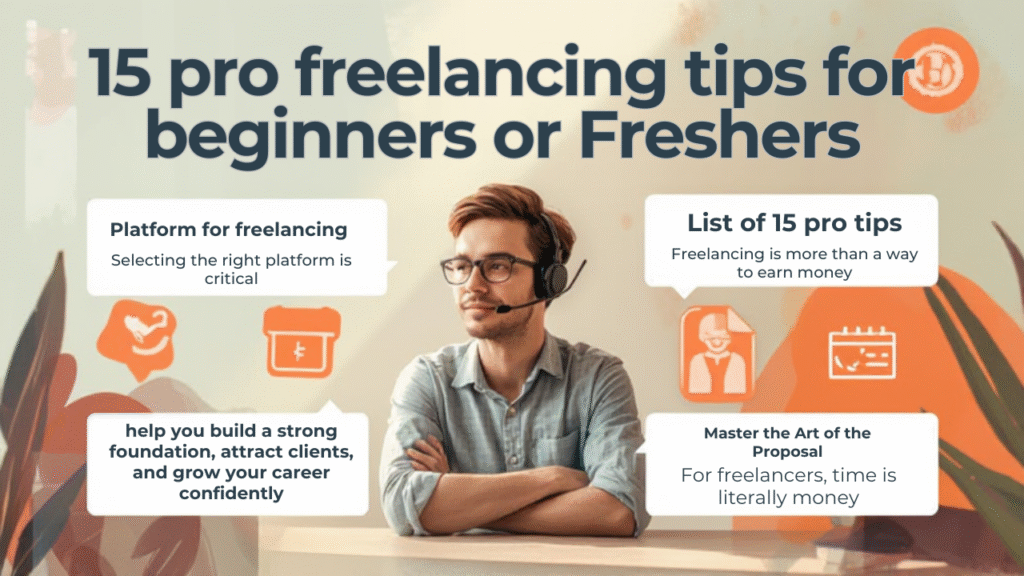
Imagine waking up every morning knowing you set your own schedule, choose your projects, and earn money doing what you love. That’s the reality freelancing can offer—but only if you navigate it smartly. The world of freelancing is exciting yet competitive, and beginners often struggle to find their footing. That’s why getting your strategy right from the start is so important. In this guide, we share 15 pro freelancing tips for beginners to help you build a strong foundation, attract clients, and grow your career confidently.
Having freelancing tips or strategy isn’t just about having a skill—it’s about creating opportunities, building relationships, and continuously improving yourself. From choosing the right platform to managing time and clients effectively, every move matters. By applying these tips, you’ll not only survive as a freelancer but thrive, turning your passion into a new career approch.
List of 15 pro tips
To excel in the freelance economy, a beginner must move beyond simply offering services and start building a disciplined business framework. These 15 pro freelancing tips for beginners are designed to instill that necessary discipline and strategic vision.
Tip 1: Go Niche or Go Nowhere
The greatest mistake a beginner freelancer can make is declaring themselves a “jack of all trades”. While versatility seems appealing, it is the antithesis of a premium service model. Niche specialization is not about limiting your potential; it’s about amplifying your value proposition. When you focus on a specific, narrow niche—such as “SaaS long-form blog content writing” or “Figma-to-Webflow development for small business e-commerce“—you move from being a general commodity to a specialist expert.
A general writer competing on Upwork might charge the median rate of $30-$40 per hour, but a “Legal Tech Policy Writer” can command well over $80 per hour due to the scarcity of their specialized knowledge. Clients are willing to pay a premium for certainty. When a client with a specific problem finds a freelancer who explicitly solves that exact problem for that exact industry, the competition vanishes. A powerful first step in implementing these 15 pro freelancing tips for beginners is to choose a niche that intersects your current skills, existing professional experience, and market demand. This narrow focus allows you to become the definitive authority quickly, justifying higher rates and attracting better-quality clients who value expertise over low cost. This freelancing tips critical for long-term freelance career success.
Tip 2: The Strategic Portfolio Build
Your portfolio is not just a collection of work; it is a carefully curated sales tool designed to eliminate risk for the client. When starting out, few beginners have paid client work, which is why the strategies for increasing your sale is one of the most essential 15 pro freelancing tips for beginners. Instead of waiting for a client, create projects for imaginary clients, known as “speculative work” or “passion projects.”
For a graphic designer, this means rebranding five well-known, outdated local businesses. For a developer, it means creating a functional, open-source micro-tool. In this freelancing tips the key is quality and relevance. Each piece in your portfolio must demonstrate:
- Problem: Clearly define the client’s hypothetical challenge (e.g., “Client X needed to increase conversion rate on their checkout page.”).
- Solution: Detail the specific steps you took (e.g., “I implemented a three-step checkout process and removed unnecessary navigation links.”).
- Result: Quantify the outcome, even hypothetically (e.g., “This design is projected to increase checkout completion by 15%”).
A portfolio built around clear case studies, rather than just pretty images or basic code, demonstrates business acumen and results-driven thinking—qualities clients prioritize highly.
Tip 3: Embrace Tiered Pricing
Beginners often fall into the trap of offering only a single hourly rate, which is limiting and confusing for clients. Pro freelancers use tiered pricing, a structure that shifts the focus from time spent to value delivered. This is one of the most financially impactful 15 pro freelancing tips for beginners.
Consider offering three packages for your service:
| Tier | Name | Focus | Price Basis | Beginner Rate Example (Writing) |
| Bronze | Starter | Basic execution, 1 round of revisions. | Hourly or small fixed-price. | $300 for 1,000 words. |
| Silver | Professional | Full service, strategy consultation, 2 rounds of revisions, light SEO optimization. | Value-based fixed project fee. | $550 for 1,000 words + strategy. |
| Gold | Partnership | Full strategy, competitive analysis, unlimited revisions, content distribution guide, 30-day post-delivery support. | Premium value-based retainer. | $900 for 1,000 words + extensive services. |
By presenting three options, you frame the discussion around which solution the client needs, rather than how little they can pay. Most clients select the middle “Silver” option because it seems like the most balanced choice. This instantly elevates your average project value (APV). These freelancing tips positions you as a consultant rather than a mere task-filler, a cornerstone of sustainable freelance career growth.
Tip 4: Define Your Client Avatar
When you don’t know who you’re speaking to, you end up speaking to no one—or worse, to low-paying, high-maintenance clients. One of the most strategic 15 pro freelancing tips for beginners is to create a detailed ‘Client Avatar.’ This isn’t just about industry; it’s about psychographics.
Ask yourself these questions:
Industry & Size: Are they a B2B SaaS startup or an established local service business?
Pain Points: What keeps them up at night? (e.g., “They are losing customers to competitors who have better branding.”)
Budget Range: What do they realistically spend on similar services? (Target clients who can afford the “Silver” or “Gold” tiers from Tip 3).
Decision Maker: Are you speaking to the CEO, the Marketing Director, or a gatekeeping assistant?
Values: Do they value speed, quality, or communication most?
By understanding your ideal client, you can tailor your profile, proposals, and communication to resonate directly with their specific challenges and financial capacity. These freelancing tips precision attracts better projects, making the execution of your freelance career significantly smoother and more rewarding.
Tip 5: Master the Art of the Proposal
A proposal is the most important sales document you will create. Most beginners treat proposals as cover letters or detailed résumés; pro freelancers treat them as sales letters focused entirely on the client’s return on investment (ROI). This is a foundational step in applying these 15 pro freelancing tips for beginners.
An effective, conversion-focused proposal structure includes:
The Hook (1-2 sentences): Acknowledge their problem immediately, proving you read and understood the job post deeper than other applicants. Example: “Your current blog traffic, though steady, is failing to convert leads because the content lacks a strong technical SEO backbone.”
Your Solution (Brief Overview): Outline a clear, three-step process for solving their problem, using language specific to their industry.
Proof (Social Validation): Reference your portfolio or a similar hypothetical project, highlighting the quantifiable results achieved.
The Investment (Tiered Pricing): Present your three-tiered tip options, making the mid-to-high tiers the most attractive choice.
Call to Action: A clear next step, typically a brief 15-minute introductory call, or a request for the initial deposit to begin work.
Crucially, keep the language confident and authoritative. Instead of saying, “I can help,” say, “We will execute a strategy to achieve X.” Statistics show that detailed, customized proposals receive hire rates up to 30% higher than generic bids.
Tip 6: The Mandatory Deposit Rule
Never, under any circumstances, begin work without a secured deposit or a clear, legally binding agreement for payment. This is not about mistrust; it is standard professional practice that protects your time and validates the client’s commitment. Among the 15 pro freelancing tips for beginners, this one ensures financial stability.
The 50/50 Model is Standard:
- 50% Deposit (Upfront): Paid before any work commences. This covers your initial planning, research, and resource allocation.
- 50% Final Payment (Upon Completion): Paid upon the delivery of the final agreed-upon work.
For long-term or high-value projects (e.g., over $5,000 or lasting more than 4 weeks), utilize a milestone system (e.g., 25% upfront, 25% at Phase 1 completion, 25% at Phase 2 completion, and 25% upon final delivery). Always use the escrow system on platforms like Upwork or a dedicated payment service like Stripe or PayPal for external clients. This financial guardrail drastically reduces the risk of non-payment, which historically affects up to 50% of beginner freelancers at some point in their freelance career, according to various industry reports.
Tip 7: Systemize the Onboarding Process
The moment a client says “Yes,” the ‘onboarding’ process begins, and it is your first opportunity to demonstrate professionalism and control. An efficient onboarding process (Tip 7 among the 15 pro freelancing tips for beginners) converts a potential client into a confident, long-term partner.
The Pro Onboarding Checklist:
Contract Signing: Use a digital signature service (like DocuSign or PandaDoc) to formalize the agreed-upon scope, deliverables, and payment terms. This contract should clearly outline the limits of revisions and project termination clauses.
Welcome & Information Kit: Send a concise, professional document that includes:
Communication Rules: State your preferred tool (e.g., Slack for quick questions, Email for official feedback) and your guaranteed response time (e.g., “I respond to all non-urgent messages within 24 hours”).
Feedback Workflow: Specify how and when you accept revisions (e.g., “Please use track changes in Google Docs and send all feedback in one consolidated email, not piecemeal throughout the day”).
Project Assets Collection (The Questionnaire): Send a questionnaire or intake form to gather all necessary assets: brand guidelines, target audience data, competitive analysis, key stakeholders, and most importantly, passwords or access credentials (using a secure, temporary service).
Kick-off Call: A brief, 30-minute meeting to review the questionnaire, set the first project milestone, and clarify any ambiguities. This ritual of clarity sets a tone of organization and eliminates future scope creep.
Tip 8: Implement Time Blocking
For freelancers, time is literally money. The lack of a manager or a fixed schedule often leads to distractions, procrastination, and ‘busy work’ that doesn’t generate income. These freelancing tips are crucial for developing discipline in your remote work environment.
Time blocking is an advanced productivity technique and a fundamental part of these 15 pro freelancing tips for beginners. Instead of keeping a vague “to-do” list, you assign specific, uninterrupted blocks of time to specific tasks in your calendar.
Focus Blocks (Deep Work): Schedule 2-3 hour blocks for revenue-generating tasks like writing, coding, or designing. Turn off all notifications.
Admin Blocks (Shallow Work): Reserve 30-60 minutes daily for emails, invoicing, and contract review. Crucially: only process these tasks during this block.
Marketing Blocks: Dedicate regular time (e.g., two hours every Friday) to sending proposals or updating your portfolio.
This technique ensures that high-value work receives your prime focus time, minimizing the eight hours per week that the average freelancer loses to inefficiency, according to recent studies on productivity in the gig economy.
Tip 9: Build a Financial Fortitude Buffer
One of the harsh realities of freelancing is the irregular income stream, which makes financial management one of the non-negotiable 15 pro freelancing tips for beginners. Pro freelancers operate with two critical buffers: The Tax Fund and The Income Gap Fund.
Sub-point A: The Tax Fund
In many countries, freelancers are responsible for estimating and paying their own income and self-employment taxes quarterly. You must immediately set aside a percentage of every single payment you receive. A good starting estimate is 25%–35% (check your local jurisdiction).
- Practical Step: Open a separate, high-yield savings account designated only for taxes. When a client pays you $1,000, immediately transfer $300 (or your target percentage) into the tax account before spending anything.
Sub-point B: The Income Gap Fund
Unlike salaried employees, freelancers don’t get paid vacation or sick leave. The Income Gap Fund is a buffer of 3 to 6 months of living expenses, held in liquid savings. This fund allows you to:
- Take high-risk, high-reward projects.
- Decline low-paying or difficult clients.
- Cover personal emergencies without panicking.
Achieving this financial buffer is a key milestone in moving from a precarious “gig worker” to a resilient, professional freelancer with financial fortitude.
Tip 10: The Test Project Strategy
Landing your first big contract can be intimidating, and clients are often hesitant to commit large budgets to a beginner. The Test Project Strategy is a low-risk mechanism for both parties, making it one of the smartest 15 pro freelancing tips for beginners.
Offer a smaller, self-contained, and clearly defined project that serves as a trial run.
Small Task: If your goal is to be a web designer, offer to redesign only the ‘About Us’ page. If you are a copywriter, offer to write three social media captions.
Fixed Low Price: Charge a fixed price well below your full hourly rate (e.g., $150-$250), emphasizing the low investment and quick turnaround.
Clear Upsell: Make it clear in the agreement that the test project serves as the foundation for the larger, more expensive contract. Example: “Successful completion of this $200 test will automatically lead to the $2,500 Phase Two engagement.”
This approach shifts the client’s risk from “Will they be good?” to “Is $150 worth finding out?” It often results in a faster “Yes” and quickly establishes a positive working relationship, which is priceless for accumulating early, high-income skill with
Tip 11: Establish a Professional Communication Protocol
Communication is the most cited non-technical skill employers look for in freelancers. Poor communication (slow replies, ambiguity, lack of follow-through) is the fastest way to derail a freelance career. Your communication protocol defines your boundary and professionalism.
The Three Pillars of Protocol:
Response Time Commitment: Explicitly state your working hours and your guaranteed response time (as detailed in Tip 7). Crucially: stick to it. If you need 48 hours to reply to a complex request, say so.
Tool Consolidation: Limit communication to two or three channels (e.g., email, Slack, and scheduled video calls). Never use personal texting or unscheduled phone calls unless the client pays a premium for “VIP access.”
End-of-Day Summary: At the close of each workday, send a brief, bulleted “End-of-Day Summary” email. This takes less than five minutes but provides immense value. Example: “Today, I completed Draft 1 of the landing page copy and scheduled the development integration meeting for tomorrow. No response needed.” This simple habit preempts client worry, demonstrating proactive management of the remote work process.
Tip 12: Leverage AI for Hyper-Efficiency
The most successful freelancers today are not being replaced by artificial intelligence; they are the ones using AI to outperform their competition. Integrating AI tools for tasks like content drafting, code snippet generation, and administrative automation is among the highest-leverage 15 pro freelancing tips for beginners. Data indicates that AI tools save the average professional up to eight hours per week.
Areas to Integrate AI:
Proposal Drafting: Use generative AI to refine your proposal’s introduction and structure, ensuring it aligns perfectly with the job description’s tone.
Code Review/Debugging: Developers can use AI assistants to quickly spot syntax errors or suggest best practices in code blocks, drastically reducing debugging time.
Content Outlines: Content writers can feed the AI the client brief and audience to instantly generate a robust, SEO-optimized content outline, saving hours of initial research.
Image Generation: Designers can use image synthesis tools to quickly create mood boards or initial concept mock-ups, allowing them to present ideas faster.
The goal is not to let AI do the core work but to use it to eliminate repetitive, time-consuming tasks, thereby allowing you to take on more projects or charge more for faster delivery.
Tip 13: Adopt the ‘T-Shaped’ Skill Model
A “T-shaped” professional has deep expertise in one core area (the vertical bar of the ‘T’) but also broad competency in several related adjacent areas (the horizontal bar). This model is vital for a robust freelance career.
Deep Skill (Vertical):
Your niche. For example, front-end development using React. This is what you market and what you charge premium rates for.
Broad Skills (Horizontal):
Complementary skills that add value. For the React Developer, this might be UX/UI Design Principles, Basic SEO, and cloud deployment (AWS/Azure).
A client doesn’t just want a React developer; they want someone who can build the UI and understand the benefits of SEO and then deploy it without major headaches. By stacking these broad, complementary skills, you become a one-stop shop, making you an exponentially more attractive hire than single-skill competitors. This strategy allows beginners to start small and incrementally increase their service offering, justifying continuous rate increases.
Tip 14: Develop a Client Exit Strategy
Not every client relationship will work out. Some pay late, others demand endless revisions, and some exhibit classic ‘scope creep’. Knowing when and how to gracefully end a relationship is a hallmark of a professional freelance career and is perhaps one of the most under-discussed 15 pro freelancing tips for beginners.
Your contract (Tip 6) must include a “Termination Clause”. This clause should stipulate:
Notice Period: A minimum notice (e.g., 7 or 14 days) is required by either party to terminate the agreement.
Payment Due: The client must pay for all work completed up to the termination date, regardless of project completion status.
Asset Handover: A clear process for handing over all work files, drafts, and assets upon final payment.
When you decide to fire a client, communicate professionally and stick to the facts: “While I appreciate the opportunity, this project’s scope has shifted beyond our initial agreement, and I am unable to allocate the necessary time. I will be finalizing all assets for handover by [Date] upon receipt of payment for the work completed to date.” This protects your reputation while freeing up your valuable time for better, more profitable clients.
Tip 15: Prioritize Continuous Skill Acquisition
In the digital world, stagnation is a death sentence. The most successful freelancers, especially Gen Z who prioritize skill development, commit to continuous learning. Studies show that roughly 65% of freelancers invested in upgrading their skills in the past year, far outpacing traditional employees.
This isn’t just about learning a new programming language; it’s about staying ahead of market trends.
The 5-Hour Rule:
Dedicate at least five hours every week to deliberate practice or learning. This could be completing a new certification, auditing an online course on a new marketing technique, or mastering a new software feature.
Focus on AI/Integration:
As AI reshapes many jobs (especially in writing and translation), focus your learning on high-demand complementary skills like AI integration, advanced data analysis, specialized prompt engineering, and complex systems architecture. These are the skills that complement automation and fetch premium hourly rates.
By consistently investing in yourself, you maintain the competitive edge necessary to implement these 15 pro freelancing tips for beginners and ensure your rates reflect increasing expertise, cementing your place in the top tier of the freelance market.
Platform for freelancing
Selecting the right platform is critical for a beginner because it directly influences the type of work you find, the competition you face, and the fees you pay. While 15 pro freelancing tips for beginners often focus on strategy, platform choice is the operational foundation of your freelance career.
The best platform is usually one that aligns with your skill level, desired project scope, and tolerance for platform fees. Here is an analysis of the top three platforms, designed to help you make an informed decision:
1. Upwork: The Marketplace of Opportunity
Model: Bid-based marketplace, suitable for a wide range of short-term tasks and long-term contracts across nearly every category (Web Dev, Writing, Design, Admin, Legal, etc.).
Best For: Beginners looking to scale a full-time freelance career and those offering services that benefit from hourly tracking and escrow protection.
Fee Structure: Upwork uses a tiered service fee structure, which rewards long-term client relationships:
- 20% for the first $500 billed with a client.
- 10% for lifetime billings between $500.01 and $10,000.
- 5% for lifetime billings over $10,000.
Pro Tip: Focus on securing a long-term contract to quickly move past the 20% tier and minimize the platform’s cut, increasing your net earnings.
Beginner Strategy: Use the Connects system strategically. Prioritise job posts that show “Payment Verified” and have a low number of proposals (fewer than 10-15) to maximize your chance of visibility. Use Tip 5 (The Proposal) to ensure your application stands out from the competition.
2. Fiverr: The Gig-Economy Micro-Service Hub
Model: Gig-based model, where the freelancer defines a service package (a ‘gig’) at a fixed price, and the client purchases it directly. It’s highly popular for microservices and creative fields.
Best For: Creative professionals (designers, video editors), or those offering highly specific, small, repeatable tasks (e.g., “I will design a logo for $75,” or “I will write 5 SEO meta descriptions for $30”).
Fee Structure: Fiverr charges a flat 20% commission on every transaction, regardless of the client’s lifetime spend. This is a high fee but is balanced by the platform’s high search volume (over 50 million monthly visits) and aggressive marketing, which sends buyers directly to your services.
Beginner Strategy: Start with low-priced “Starter Gigs” to rapidly gain reviews and ratings, which boosts your visibility in the search algorithm. Once you have 5-10 5-star reviews, use Tip 3 (Tiered Pricing) to create Bronze, Silver, and Gold packages for the same service, increasing your revenue while maintaining your high rating.
3. People Per Hour (PPH) and Localized Platforms
Model: Hybrid model combining fixed-price “Offers” (similar to Fiverr Gigs) and a bidding system for posted jobs. It often has less global competition than Upwork or Fiverr, especially for new accounts.
Best For: Beginners and those based in regions where the platform is highly popular (such as Europe and India). It is generally seen as a friendlier starting point for obtaining initial projects and building confidence, a key component of these 15 pro freelancing tips for beginners.
Fee Structure: PPH uses a tiered fee structure based on lifetime earnings with a client, similar to Upwork, but with slightly different breakpoints (e.g., 15% for the first £250, then dropping down).
Beginner Strategy: Focus on the “Hourlie” (their name for a fixed-price service) feature, as these are often favoured by clients looking for quick, defined tasks. Use your 15 free monthly proposal credits wisely, applying only to jobs that match your niche (Tip 1).
Top-Tier Freelance Projects for Impact and Income
The “best” projects are those that move beyond simple task completion and offer comprehensive, strategic solutions, leading to higher rates and stronger client relationships.
First 5 freelance projects:
| Category | Recommended Strategic Project | Why it’s the “Best” |
| 1. Digital Marketing | The Full-Funnel Growth Overhaul | Instead of running a single campaign, offer a complete strategy: audit existing channels, define ideal customer profiles (ICPs), map the entire buyer journey, and implement tracking and attribution across email, ads, and SEO. This shifts you from a vendor to a strategic partner. |
| 2. Social Media Marketing | Data-Driven Short-Form Video Strategy Launch | Focus on launching a 90-day strategy (TikTok/Instagram Reels/YouTube Shorts) for a B2C brand, with the primary goal of driving traffic or conversions, not just views. The deliverable is not just content, but proven conversion metrics tied to the video strategy. |
| 3. SEO | E-commerce Technical and Content Audit + Implementation | Offer a deep dive into technical issues (site speed, core web vitals, indexability) combined with a content gap analysis. The scope must include hands-on implementation and a 6-month ranking roadmap. This targets the highest-impact SEO fixes for tangible ROI. |
| 4. Performance Marketing | B2B High-Value Lead Generation Funnel Build | Develop and manage a new Pay-Per-Click (PPC) lead-gen campaign for a high-ticket B2B service (e.g., SaaS, consulting). Success is measured not just by clicks but by optimizing the Cost-Per-Qualified-Lead (CPQL) and demonstrating pipeline value. |
| 5. Graphics Designing | New Startup Brand Style Guide & Core Asset Library | This project involves more than just a logo. You deliver a complete, detailed style guide (typography, colour palettes, voice/tone) and 10-15 core assets (social templates, pitch deck background, email signature). This establishes you as the custodian of the visual brand. |
Next 5 freelance projects:
| 6. Website Development | Marketing Ecosystem Landing Page Build (Webflow/React) | Create a set of high-converting, modular landing pages optimized for speed and conversion (A/B testing ready). Use modern, no-code/low-code platforms (like Webflow) or React/Next.js for blazing fast performance. Focus on conversion rate optimization (CRO) in addition to design. |
| 7. Content Writing | The Pillar Page and Content Cluster Project | Write one comprehensive, authoritative “pillar page” (2,000+ words) covering a major topic and three supporting “cluster articles” that link back to it. This demonstrates deep subject matter expertise and helps the client dominate a specific search topic, leading to better long-term retainers. |
| 8. Content Creator | Mini-Series/Micro-Documentary Production | Produce a short (3-5 episode) narrative or documentary series for a niche B2B brand or non-profit organization focused on industry insights or impact. This requires high production value and storytelling skill and offers a high-profile, premium portfolio piece. |
| 9. Influencer | Niche Product Launch Micro-Influencer Campaign | Instead of massive reach, manage a campaign utilizing 10-20 hyper-focused micro-influencers (2k-10k followers) in a specialized niche. The goal is high engagement and conversion via trackable affiliate links/codes, showcasing your ability to deliver measurable ROI over vanity metrics. |
| 10. Video Editing | Branded YouTube Channel Automation Package | Offer a retainer package that covers the full post-production pipeline for a client’s dedicated YouTube channel: cutting, motion graphics, sound design, title sequences, and A/B testing thumbnail designs. This moves beyond one-off edits to a reliable, high-volume production partnership. |
FAQ: Freelancing Tips for Beginners
Q1: How much can a beginner freelancer earn?
A: Earnings vary widely, but beginners can start with $5-$25 per hour depending on skills and platform. Specialized skills and high-quality portfolios increase income potential.
Q2: How do I find my first client?
A: Start with freelancing platforms, social media networking, and personal connections. Offering free or discounted initial projects can build credibility and reviews.
Q3: Do I need a contract for every project?
A: Yes. Contracts protect both you and your client, ensuring clear expectations and payment terms. Even small projects benefit from clear agreements.
Q4: How can I increase my freelancing rates?
A: Gain experience, specialize in a niche, showcase a strong portfolio, and maintain client satisfaction. Continuing education and certifications also justify higher rates.
Q5: Is freelancing a sustainable long-term career?
A: Yes, with strategic planning, continuous skill development, and proper financial management, freelancing can provide long-term stability and growth.
Conclusion
Freelancing is more than a way to earn money—it’s a journey of independence, growth, and creativity. By applying these 15 pro freelancing tips for beginners, you can navigate challenges, seize opportunities, and carve a new career approach that aligns with your passions. Every successful freelancer started as a beginner, learning the ropes and gradually building expertise, reputation, and confidence. Remember, persistence, adaptability, and continuous learning are your strongest allies in this dynamic world. Take the first step today, refine your skills, and embrace the freedom that freelancing brings—your future as a thriving freelancer is in your hands.

