

Quick Answer
The Skyscraper Technique is an SEO link-building strategy that involves finding content that already attracts backlinks, creating a more valuable and distinctive resource, and reaching out to relevant websites that link to the original. Its purpose is to earn quality backlinks by giving publishers a genuine reason to reference your content.
Ever wondered why some blog posts attract hundreds of backlinks while equally informative articles barely get noticed? The difference often comes down to how valuable and reference-worthy the content is. The Skyscraper Technique helps you understand what makes existing content successful and how to create something even more useful.
But here’s the catch: simply writing a longer article or adding a few extra images won’t make your content stand out. You need fresh insights, practical information, and a clear reason for other websites to reference your work. Let’s explore how to make that happen.
What Is the Skyscraper Technique in SEO?
Popularised by SEO expert Brian Dean in 2015, the Skyscraper Technique is a content-led link-building method. It involves finding a page that has earned backlinks, creating a more useful alternative, and contacting relevant websites that reference the original.
The name comes from the idea of building something taller than an existing skyscraper. In SEO, this means improving on an established resource through better information, practical examples, original research, and a stronger user experience.
The technique connects content marketing with link building in SEO. Instead of requesting backlinks without offering value, you create a resource that publishers may genuinely want to reference.
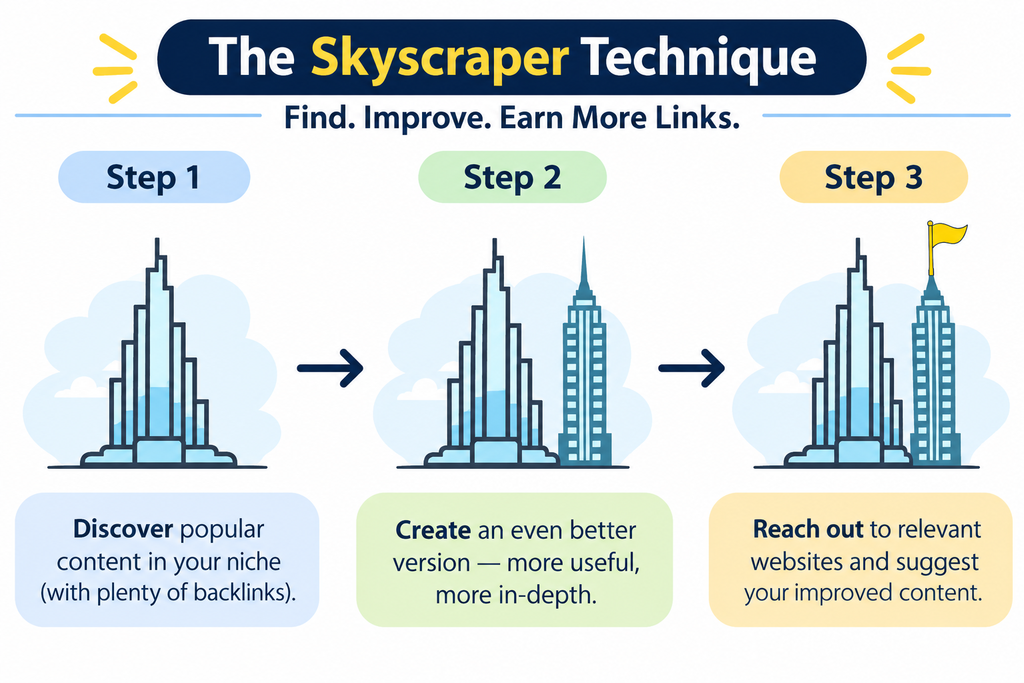
The original process has three stages:
- Find content that already attracts backlinks.
- Create a more valuable and differentiated resource.
- Contact relevant websites linking to the original.
The principle is simple: create something worth referencing before asking anyone to link to it.
How Does the Skyscraper Technique Work?
A successful campaign requires research, content development, and targeted promotion. Each stage should have a clear purpose.
1. Find Content That Already Attracts Backlinks
Start by identifying popular pages in your niche that have earned backlinks. Tools such as Ahrefs, Semrush, and Moz can help you examine competitor pages and their backlink profiles.
Look beyond the total number of links. Consider:
- Referring domains and their relevance.
- The context in which the links appear.
- The type of content attracting references.
- Information that is outdated, incomplete, or unclear.
A page with fewer links from relevant websites may offer a better opportunity than one with hundreds of unrelated backlinks. A proper backlink analysis helps you understand why a resource attracts links and where your own content could offer something better.
2. Create a More Valuable and Differentiated Resource
Once you identify a suitable competitor page, examine its strengths and weaknesses. Your objective is not to rewrite it with additional paragraphs but to address gaps that matter to readers.
For example, if an existing keyword research guide explains how to find keywords but does not demonstrate how to group them or organise a content plan, those gaps could become the foundation of your article.
Improve your resource through:
- Original research, data, or firsthand observations.
- Accurate and updated information.
- Practical examples, screenshots, and templates.
- Clear explanations and logical headings.
- Useful comparisons and actionable steps.
Understanding the types of backlinks the competing page attracts can also help you decide what kind of resource would be most useful to publishers.
Google’s people-first content guidance encourages original information, research, and substantial additional value rather than simply rewriting existing material.
3. Find Relevant Websites and Conduct Targeted Outreach
After publishing your resource, identify websites linking to the original page. These publishers have already shown an interest in the subject, making them potential outreach prospects.
Review each linking page and consider whether your resource would genuinely improve it. Then:
- Identify relevant websites from the competitor’s backlink profile.
- Remove unsuitable or unrelated prospects.
- Find a specific reason your resource could add value.
- Send a short, personalised email.
- Follow up politely and track responses.
Your message should explain what the publisher or reader gains from your resource. Avoid generic emails that simply claim your article is better and request a link.
The goal is to earn editorial links through relevance and usefulness, not to collect placements from unrelated websites.
Why the Traditional Skyscraper Technique Needs an Update
The original method remains useful, but the content environment has changed. Many topics already have extensive online coverage, so simply publishing a longer article is unlikely to create a meaningful advantage.
1. Content Saturation: Why Longer Content Is Not Enough
Content volume has increased, partly because AI tools make publishing easier. An Ahrefs study published in May 2025 found that 74.2% of 900,000 newly detected English-language webpages from April 2025 contained some AI-generated content. This finding applies to that specific dataset, not the entire internet.
The important lesson is that publishing more content does not automatically make it more valuable.
Focus on information gain: what does your page contribute that readers cannot easily find elsewhere? Original findings, practical experiments, expert insights, and useful templates can help distinguish your resource from competing pages.
2. E-E-A-T, Original Research, and Firsthand Experience
Google uses E-E-A-T—Experience, Expertise, Authoritativeness, and Trustworthiness—as a framework for evaluating qualities associated with helpful and reliable content. E-E-A-T is not a single direct ranking factor, but its principles are useful when developing trustworthy resources.
For a Skyscraper campaign, demonstrate credibility through:
- Firsthand experience and practical examples.
- Properly attributed statistics and research.
- Expert contributions where relevant.
- Accurate explanations and transparent limitations.
- Regular reviews of outdated information.
For example, when writing about an SEO tool, include observations from actually using it instead of repeating its feature list. The aim is to provide evidence and usefulness, not simply claim expertise.
3. Outreach Fatigue: Moving Beyond Mass Emails
Publishers regularly receive requests to link to supposedly better articles. Sending more emails does not solve the problem when the resource offers no distinctive value.
This is where digital PR for SEO can complement traditional outreach. Original surveys, industry reports, expert commentary, and data-led research give publishers stronger reasons to reference your work.
Personalised outreach still matters, but it should support a genuinely useful resource rather than rely on repetitive backlink requests.
The Signal Tower Framework (STF): A Modern Approach
The Signal Tower Framework (STF), proposed by Metaflow, offers a modern way to approach the Skyscraper Technique. It focuses on identifying opportunities, establishing original value, matching search intent, and earning editorial visibility.
It is a proposed framework, not an official Google standard or ranking factor.
1. Scan: Identify Search Opportunities
Study search results, competing pages, and audience questions. Identify what existing resources cover well and where readers still need better answers.
2. Signal: Establish Genuine Information Gain
Decide what makes your content different. This could include original research, firsthand evidence, expert contributions, or a practical framework.
Metaflow also proposes an IG-9 information-gain scorecard, with a suggested threshold of seven out of nine before production. This is its own editorial assessment method, not a universal SEO requirement.
3. Intent: Match Searcher Needs
Understand whether people want a definition, tutorial, comparison, or solution. Organise your content around that need, using clear headings and concise explanations.
4. Earn: Build Editorial Visibility
Create resources that publishers have a genuine reason to reference. Use relevant outreach and digital PR to introduce your research, insights, and practical assets to suitable audiences.
| Traditional approach | Modern STF approach |
| Find popular content | Scan search results and content gaps |
| Create a better resource | Signal original information |
| Improve content coverage | Match search intent |
| Conduct backlink outreach | Earn editorial visibility through targeted PR |
Both approaches aim to create content worth referencing. STF places additional emphasis on originality and the reason publishers would cite a resource.
Practical Example: Applying a Modern Skyscraper Strategy
Imagine you want to publish a keyword research guide for beginners. Several established SEO websites already have detailed guides that attract backlinks.
Instead of immediately writing a longer article, examine what those resources cover and identify missing information.
Step 1: Research competitors. Review their content, backlink profiles, and the websites linking to them.
Step 2: Find a content gap. You discover that many guides explain keyword discovery but offer limited guidance on grouping keywords and preparing a content plan.
Step 3: Create a better resource. Develop a guide with a worked example, keyword-clustering template, screenshots, and a practical workflow.
Step 4: Identify publishers. Prioritise websites whose readers would benefit from the additional material. Also explore opportunities such as resource page link building when your guide is genuinely suitable for a curated resource list.
Step 5: Promote the guide. Send personalised messages explaining how your resource could improve an existing page. Track responses and placements without assuming that every prospect will link to it.
This is an illustrative example, not a report of an actual campaign or guaranteed result.

How to Measure the Success of a Skyscraper Campaign
Backlink numbers alone do not show whether a campaign is successful. Evaluate the quality of acquired links and whether the resource attracts relevant visitors and improves organic visibility.
| Metric | What to monitor |
| Referring domains | Number of unique websites linking to your page |
| Link relevance | Context and relevance of linking pages |
| Outreach responses | Publisher engagement with your campaign |
| Backlink placements | New links earned |
| Referral traffic | Visitors arriving through backlinks |
| Organic performance | Clicks, impressions, and keyword visibility |
| Brand mentions | References to your resource or brand |
Understand dofollow and nofollow links when reviewing backlink attributes, but do not judge a link’s value solely by whether it passes ranking signals. Relevant mentions can also introduce your brand to the right audience.
Use Google Search Console to monitor organic performance and backlink tools to track new and lost referring domains. Remember that rankings can change for several reasons, so do not attribute every improvement to a single campaign.
Common Mistakes to Avoid
Avoid these common mistakes when planning and executing your campaign:
- Adding words without value: Longer content is not automatically better.
- Copying competitor content: Rewriting existing information does not create originality.
- Ignoring search intent: Match the resource to what readers actually want.
- Using unverified information: Check statistics, examples, and references.
- Sending mass emails: Personalise outreach and explain the value.
- Targeting irrelevant websites: Prioritise relevant publishers and audiences.
- Expecting guaranteed results: No strategy guarantees backlinks or rankings.
Also consider opportunities such as broken link building when a relevant website links to a missing resource and your content offers a suitable replacement. The replacement should genuinely serve the same purpose as the original.
Is the Skyscraper Technique Still Effective in 2026?
Yes, the underlying principle remains useful, but its execution needs to evolve. Finding successful content, improving it, and building relevant publisher relationships are still practical SEO activities.
What has changed is the standard for creating something better. Original research, firsthand experience, accurate information, search-intent alignment, and useful content assets now play an important role in differentiation.
Clear definitions, descriptive headings, logical organisation, and properly attributed evidence can also make content easier for readers and AI-powered search systems to understand. However, no particular GEO tactic guarantees inclusion in Google AI Overviews or other AI-generated answers.
The strongest approach is to create resources that deserve attention rather than treating backlinks as the only reason to publish.
Frequently Asked Questions
1. What is the Skyscraper Technique in SEO?
It is a link-building strategy that involves finding content with existing backlinks, creating a more useful alternative, and contacting relevant websites that link to the original.
2. Who introduced the Skyscraper Technique?
SEO expert Brian Dean popularised the technique in 2015 through a Backlinko case study.
3. What is Skyscraper 2.0?
Skyscraper 2.0 is an evolution of the original approach that places greater emphasis on matching search intent instead of simply making content longer or more comprehensive.
4. What is the Signal Tower Framework?
It is a proposed framework from Metaflow with four stages: Scan, Signal, Intent, and Earn. It focuses on content gaps, original value, search intent, and editorial visibility.
5. Is the Skyscraper Technique still effective?
Yes, when the resource offers genuine improvements and outreach targets relevant publishers. Simply publishing longer content or sending mass emails is unlikely to be enough.
6. Which tools can help with the Skyscraper Technique?
Ahrefs, Semrush, and Moz can help analyse competitor backlinks and identify opportunities. Google Search Console helps monitor organic performance.
7. Does the Skyscraper Technique guarantee backlinks?
No. Publishers decide independently whether a resource deserves a reference. Content quality, relevance, credibility, and editorial suitability all matter.
Conclusion
The Skyscraper Technique remains a practical way to combine competitor research, content development, and link-building outreach. However, success depends on offering more than a longer version of an existing article. Focus on genuine content gaps, original information, search intent, and relevant publisher relationships.

