Quick Answer
An ecommerce marketing strategy is a planned approach to attracting potential buyers, converting visitors into customers, and generating repeat purchases. It increases sales by bringing in relevant traffic, improving the shopping experience, increasing order value, and using performance data to make better decisions. The goal is profitable growth, not simply more website visits.
Imagine spending money on ads, posting regularly on social media, and getting visitors to your online store, yet sales barely improve.
Frustrating, right?
A well-planned ecommerce marketing strategy helps you understand why people aren’t buying instead of spending more money hoping something will work.
The interesting part is that you don’t always need more traffic to increase sales. Sometimes, fixing a product page, simplifying checkout, or encouraging existing customers to return can make a bigger difference.
Here’s how to identify those opportunities using actual business data.
How Does an Ecommerce Marketing Strategy Actually Increase Sales?
An online store’s revenue depends on three important factors:
Revenue = Website Visits × Purchase Conversion Rate × Average Order Value
Consider this hypothetical example:
| Metric | Before | After |
| Monthly visitors | 10,000 | 10,000 |
| Conversion rate | 2% | 2.5% |
| Average order value | ₹1,000 | ₹1,100 |
| Monthly revenue | ₹2,00,000 | ₹2,75,000 |
Revenue increases by 37.5% without additional traffic. This isn’t a guaranteed result, but it demonstrates how improving conversions and order value can affect sales.
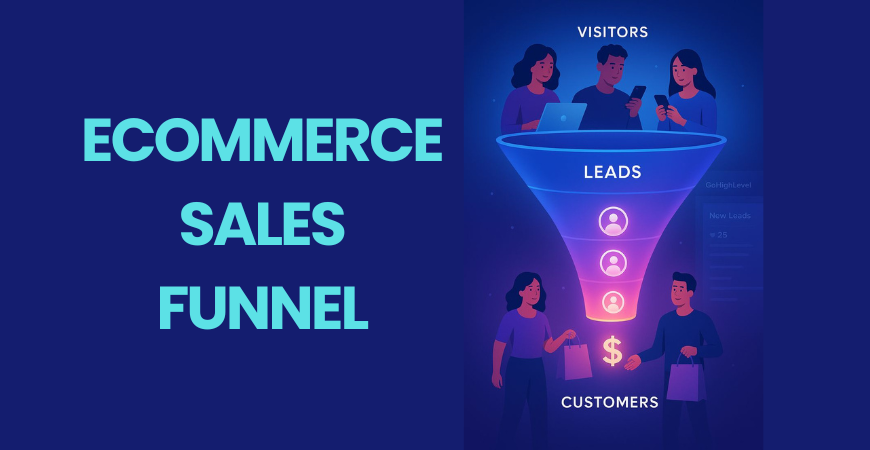
Understanding the ecommerce sales funnel helps businesses identify whether they need more qualified visitors, better product experiences, or improvements during checkout.
How Can You Identify What Is Stopping Your Ecommerce Sales?
Before investing in another campaign, examine where potential customers leave your store.
Google Analytics 4 (GA4), Google Search Console, and ecommerce platform reports can help reveal these patterns.
| What the data shows | What to investigate |
| High traffic, few orders | Traffic quality and landing pages |
| Many product views, few add-to-carts | Product details, pricing, trust |
| Many add-to-carts, few purchases | Checkout and delivery costs |
| Rising orders, falling profit | Advertising costs and discounts |
| Few repeat purchases | Customer experience and follow-up |
These patterns suggest where to investigate; they don’t prove the cause.
Effective ecommerce analytics helps businesses prioritize improvements based on evidence rather than assumptions.
How Can You Attract Shoppers Who Are More Likely to Buy?
Not every visitor arrives with the same intention.
Someone searching for “how to choose running shoes” may be researching, while someone searching for “buy running shoes size 9” is closer to making a purchase.
Understanding search intent helps you create the right experience for each shopper. Informational queries may need buying guides, while purchase-focused searches need relevant product or category pages.
Check Google Search Console to identify which queries attract visitors and whether those landing pages match what shoppers expect.
Use Ecommerce SEO to Reach Relevant Buyers
Effective ecommerce SEO also involves optimizing product titles, category pages, descriptions, and product information around relevant searches.
For example, a descriptive title such as “Men’s Lightweight Running Shoes, Size 9” communicates more useful information than “Premium Sports Shoes.”
Google Merchant Center also recommends accurate product information, including prices, availability, images, and relevant attributes.
How Can You Convert More Product Visitors Into Customers?
Getting someone onto a product page doesn’t guarantee a sale.
Imagine two stores selling the same shoes. One provides a single image and a generic description. The other includes sizing guidance, multiple images, delivery information, customer reviews, and a clear return policy.
The second page answers more questions that might otherwise prevent a purchase.
Good product page optimization starts with understanding what customers need to know. Review support queries, product feedback, and common questions to identify missing information.
Track product views, add-to-cart events, and purchases to evaluate whether improvements help customers move closer to buying.
Why Should You Fix Checkout Problems Before Increasing Ad Spend?
A customer adds a product to their cart, starts checkout, and discovers an unexpected shipping charge. They leave without purchasing.
That is a potential sale lost after the business has already attracted an interested shopper.
Research from Baymard Institute identifies unexpected costs, compulsory account creation, and complicated checkout experiences among common reasons for cart abandonment.
Consider a store with 500 checkout starts and 200 purchases. Its checkout completion rate is 40%. If that improves to 45%, the same number of checkout starts would generate 225 purchases.
This is an illustrative calculation, not a predicted outcome.
Use GA4 checkout events, payment error reports, and customer feedback to investigate why shoppers leave. Fixing genuine friction may be more valuable than immediately increasing advertising spend.
How Can You Increase Sales Without Getting More Traffic?
Two opportunities deserve attention: increasing order value and encouraging existing customers to return.
Increase Average Order Value With Relevant Recommendations
Suppose a skincare store sells a cleanser for ₹600. Recommending a compatible moisturizer for ₹400 could increase an individual order to ₹1,000 if the customer buys both.
Relevant bundles, complementary products, and carefully calculated free-shipping thresholds can improve average order value.
However, always consider discounts, shipping subsidies, and product margins. Higher revenue doesn’t automatically mean higher profit.
Encourage Existing Customers to Purchase Again
A customer who already trusts your store may return when they need another product.
For example, a skincare brand could send replenishment reminders based on typical product usage, while respecting customers’ communication preferences.
Strong customer retention depends on product quality, reliable service, relevant follow-ups, and understanding when customers are likely to need something again.
Measure repeat purchase rate and customer lifetime value rather than assuming every promotional email creates additional sales.
How Do You Know Which Marketing Channels Deserve Your Budget?
More clicks don’t necessarily mean better business results.
Consider this hypothetical comparison:
| Metric | Campaign A | Campaign B |
| Advertising spend | ₹10,000 | ₹10,000 |
| Orders | 50 | 30 |
| Revenue | ₹25,000 | ₹30,000 |
| Gross margin | 30% | 50% |
| Gross profit before ads | ₹7,500 | ₹15,000 |
Campaign A generates more orders, but Campaign B produces more gross profit. After advertising costs, Campaign A loses ₹2,500, while Campaign B retains ₹5,000 before other expenses.
This illustrates why businesses should evaluate customer acquisition costs, margins, and profitability instead of judging campaigns only by traffic or order volume.
How to Build a 30-Day Ecommerce Marketing Strategy Around Sales Data
You don’t need to change everything immediately. Start with one measurable problem.
| Period | Action |
| Week 1 | Review traffic, product activity, checkout events, and sales |
| Week 2 | Identify and prioritize the biggest revenue opportunity |
| Week 3 | Implement one focused improvement |
| Week 4 | Compare performance and decide what to test next |
For example, if mobile checkout completion is much lower than desktop completion, investigate mobile payment errors, form usability, and page performance before redesigning the entire website.
A 30-day review provides structure, but smaller stores may need more time to collect reliable data.
Which Metrics Show Whether Your Strategy Is Working?
A successful strategy should improve measurable business outcomes.
| Metric | What it measures |
| Purchase conversion rate | Percentage of visits resulting in orders |
| Average order value | Revenue generated per order |
| Revenue per visitor | Average revenue generated per visit |
| Customer acquisition cost | Cost of acquiring a new customer |
| Repeat purchase rate | Percentage of customers who buy again |
| Contribution margin | Revenue remaining after relevant variable costs |
An improving ecommerce conversion rate can indicate better purchasing performance, but it should be evaluated alongside revenue, acquisition costs, and profit margins.
Compare results over suitable periods and examine differences between mobile and desktop users, marketing channels, and customer groups.
Why Practical Ecommerce Marketing Skills Matter for Business Growth
Increasing online sales requires more than knowing how to run ads or write product descriptions. It involves understanding SEO, analytics, customer behaviour, paid campaigns, and conversion optimization together.
Academy of Digital Marketing (ADM) covers these connected skills through its practical digital marketing course, helping learners understand how marketing activities contribute to measurable business outcomes.
Learning to interpret real performance data and identify growth opportunities is particularly valuable for aspiring digital marketers.

Frequently Asked Questions
Can an ecommerce marketing strategy increase sales without more traffic?
Yes. Improving conversion rates, average order value, and repeat purchases can increase revenue even when visitor numbers remain unchanged.
Which ecommerce marketing strategy works best for small businesses?
The best approach depends on the store’s biggest problem. Businesses should identify whether they need more qualified visitors, better conversions, or stronger customer retention before choosing tactics.
How much should an ecommerce business spend on marketing?
There is no universal budget. Consider profit margins, acquisition costs, available resources, and business goals. Start with manageable spending and scale when performance supports it.
What is the most important metric for ecommerce sales growth?
Revenue and profitability are essential outcomes, while conversion rate, average order value, acquisition cost, and repeat purchases help explain what drives them.
How long does it take to see results?
Some checkout and product-page improvements may show changes relatively quickly. SEO and retention strategies often take longer, depending on traffic, competition, and implementation quality.
Conclusion
An effective ecommerce marketing strategy increases sales by identifying what prevents visitors from buying and improving the parts of the shopping experience that matter most. Rather than spending blindly on more traffic, businesses should examine customer behaviour, remove purchasing barriers, increase order value, and encourage repeat purchases. The smartest starting point is simple: find your biggest sales opportunity in the data, improve it, and measure the results.