
Quick Answer
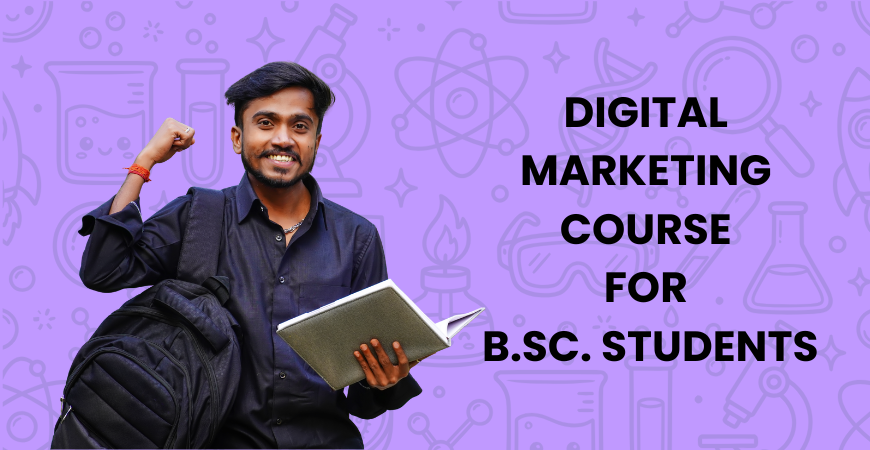
Yes, B.Sc. students can build a career in digital marketing without having a business or management degree. A digital marketing course for B.Sc. students can help them develop practical knowledge in SEO, social media, advertising, content marketing, and analytics while applying their science background in a new professional field.
A B.Sc. degree can lead to careers in research, education, technology, and other science-related fields. However, students who want to explore a different professional direction can also consider digital marketing. A digital marketing course for B.Sc. students can introduce them to online platforms, marketing strategies, and tools used by businesses.
Digital marketing welcomes graduates from different academic backgrounds. You do not necessarily need a marketing degree to enter the field. What matters is your willingness to learn, understand audiences, use digital tools, and apply your knowledge through practical work. Your science education can provide a useful starting point for developing these abilities.
Can B.Sc. Students Build a Career in Digital Marketing?
Yes. Most digital marketing roles focus on practical skills, marketing knowledge, communication, and an understanding of online platforms rather than a specific undergraduate degree. B.Sc. graduates can explore this field by combining their academic strengths with relevant marketing skills. A digital marketing course for B.Sc. students can provide a structured introduction to the concepts and tools used in this industry.
How Does a Science Background Help in Digital Marketing?
Science education often involves research, observation, problem-solving, and interpreting information. These abilities can be useful in digital marketing, where decisions about content, audiences, and campaigns often depend on analysing information.
| Science-related ability | Digital marketing application |
| Analytical thinking | Evaluating campaign performance |
| Research skills | Keyword and audience research |
| Data interpretation | Understanding website and advertising reports |
| Problem-solving | Identifying SEO or campaign issues |
| Subject knowledge | Developing specialised industry content |
For example, if a website receives visitors but very few enquiries, a marketer may investigate its landing page, traffic sources, search intent, and user behaviour before suggesting changes. A systematic approach to understanding problems can help with this process.
However, a science degree does not automatically provide marketing knowledge. Students still need to learn how search engines, advertising platforms, content strategies, and customer behaviour work. Developing these abilities alongside existing strengths can make their background valuable. You can explore essential digital marketing skills to understand what beginners should learn.
Which Digital Marketing Careers Can B.Sc. Students Explore?
B.Sc. graduates can consider different entry-level roles depending on their interests and the skills they develop. Learning through a digital marketing course for B.Sc. students can help them understand the responsibilities and requirements of different career paths.
| Career option | Main responsibilities |
| SEO Executive | Improving website visibility in organic search results |
| Digital Marketing Executive | Supporting campaigns across multiple digital channels |
| Social Media Executive | Planning content and managing brand communication |
| Content Marketing Executive | Creating useful content for target audiences |
| Performance Marketing Executive | Managing and evaluating paid advertising campaigns |
| Digital Marketing Analyst | Studying website and campaign performance data |
Your science specialisation may also influence the areas you find interesting:
- Computer Science and IT: Technical SEO, website management, and analytics.
- Mathematics and Statistics: Data analysis, campaign reporting, and performance marketing.
- Biology and Chemistry: Healthcare, pharmaceutical, and science-related content.
- Physics and other science subjects: Research-driven content and technical communication.
These are possible areas of interest, not fixed career paths. You can explore different digital marketing career options and choose one that matches your abilities and professional goals.
What Skills Should B.Sc. Students Learn to Enter Digital Marketing?
Digital marketing involves several connected activities. Beginners should understand the major channels before deciding whether to specialise in one area. A digital marketing course for B.Sc. students may cover the following essential skills:
- Search Engine Optimisation (SEO): Learn keyword research, search intent, on-page optimisation, internal linking, and basic technical SEO.
- Google Ads: Understand paid search campaigns, audience targeting, advertising budgets, and conversion tracking.
- Social Media Marketing: Learn how businesses use platforms such as Instagram, Facebook, and LinkedIn to reach audiences.
- Content Marketing: Develop research, writing, editing, and content-planning skills.
- Website Management: Understand website structure, WordPress, landing pages, and basic optimisation.
- Analytics and Reporting: Learn to measure website traffic, engagement, and campaign results using tools such as Google Analytics.
- AI Tools: Explore how AI can support research, brainstorming, and content planning while checking generated information for accuracy and relevance.
Do B.Sc. Students Need Coding or Previous Marketing Knowledge?
No. Coding is not essential for most beginner-level digital marketing roles. However, basic knowledge of HTML, website structure, or technical concepts can be helpful in areas such as technical SEO and website management.
Previous marketing experience is not mandatory either. Students can begin by learning how businesses identify customers, communicate value, and encourage people to take action. Regular practice helps turn these concepts into useful skills.
How Can B.Sc. Students Gain Practical Experience?
Practical experience helps students understand how digital marketing works beyond textbooks and tutorials. Students taking a digital marketing course for B.Sc. students can look for opportunities to apply their learning through assignments, independent practice, and portfolio projects.
For example, a B.Sc. Biology student could plan a digital marketing project for a hypothetical healthcare website:
- Research the audience and the information they may search for.
- Prepare an SEO content plan using relevant search queries.
- Optimise sample website pages with suitable titles, headings, and descriptions.
- Create educational social media posts.
- Outline a basic advertising campaign.
- Identify metrics such as website visits, engagement, and enquiries to evaluate performance.
This would be a simulated project, not a record of results for an actual business. Students can document their research, decisions, and sample work to begin building a portfolio. Exploring digital marketing projects can provide more ideas for practical assignments.
Internships can offer another opportunity to understand professional workflows, including keyword research, content planning, campaign support, and reporting. Students without work experience can explore digital marketing internship opportunities to understand application requirements and the skills employers expect.
Is a Digital Marketing Course Worth It for B.Sc. Students?
A digital marketing course for B.Sc. students can provide a structured way to learn different marketing channels, practise with relevant tools, and understand how campaigns work together. Self-learning is also possible through online tutorials and free resources, but organising topics into a complete learning path may take time.
Before choosing a programme, evaluate these factors:
| Factor | What to check |
| Syllabus | SEO, advertising, social media, content, and analytics |
| Practical learning | Assignments and individual or live projects |
| AI integration | Relevant tools and responsible usage |
| Internship | Whether opportunities are available and what they involve |
| Certification | The issuing organisation and what the certificate represents |
| Faculty | Relevant industry experience |
| Career support | Portfolio, interview, and job-preparation guidance |
| Learning format | Classroom, online, or blended options |
A digital marketing course syllabus can help you check whether a programme covers the topics you want to learn. Also, look for practical digital marketing training that allows you to apply concepts, receive feedback, and understand how marketing performance is evaluated.
A course alone does not guarantee employment. Your practical knowledge, portfolio, communication skills, and ability to demonstrate what you have learned remain important.
How Can ADM Help B.Sc. Students Develop Digital Marketing Skills?
Students considering a digital marketing course for B.Sc. students can explore programmes that combine foundational concepts with practical learning. Academy of Digital Marketing (ADM) offers classroom and online learning options.
Its programmes have different durations and learning levels:
| ADM programme | Duration |
| AI Generative Master Program in Digital Marketing | 10 months |
| AI Powered Diploma Program in Digital Marketing | 7 months |
| AI Integrated Certificate Program in Digital Marketing | 4 months |
| Principal Program in Digital Marketing | 2 months |
| Foundation Program in Digital Marketing | 1.5 months |
The right programme depends on your existing knowledge, learning goals, and available time. Beginners may prefer to understand the fundamentals before moving towards specialised areas. Comparing digital marketing course duration can help you assess the time commitment involved.
Want to Know More About ADM?
Not sure which programme fits your career goals, learning preferences or available time? Then,
Frequently Asked Questions
1. Can I learn digital marketing after completing a B.Sc.?
Yes. Graduates from Biology, Chemistry, Mathematics, Physics, Computer Science, and other science streams can learn digital marketing. A digital marketing course for B.Sc. students can provide a starting point for understanding the fundamentals, followed by regular practice through assignments and projects.
2. Which digital marketing job is suitable for B.Sc. graduates?
It depends on your interests. Research-oriented students may explore SEO or content marketing, while those comfortable with numbers may consider analytics or performance marketing. Social media and general digital marketing roles are other options.
3. Do B.Sc. students need coding to learn digital marketing?
No. Coding is not required for most entry-level digital marketing activities. Basic technical knowledge can still be useful for website management and technical SEO.
4. Is digital marketing a good career option after B.Sc.?
It can be a suitable option for graduates interested in technology, research, communication, and consumer behaviour. Career growth depends on developing relevant skills and gaining practical experience.
5. How long does it take to learn digital marketing?
The time required depends on the topics covered, your previous knowledge, and how regularly you practise. Understanding the fundamentals may take less time than developing confidence across SEO, advertising, analytics, and other areas.
Conclusion
B.Sc. students do not have to limit themselves to careers directly related to their science specialisation. Their research, analytical, and problem-solving abilities can provide a useful foundation for digital marketing. A digital marketing course for B.Sc. students can help them build practical knowledge in SEO, content, social media, advertising, and analytics. By practising through projects and developing a portfolio, they can explore different roles and turn their academic strengths into valuable professional skills.

