
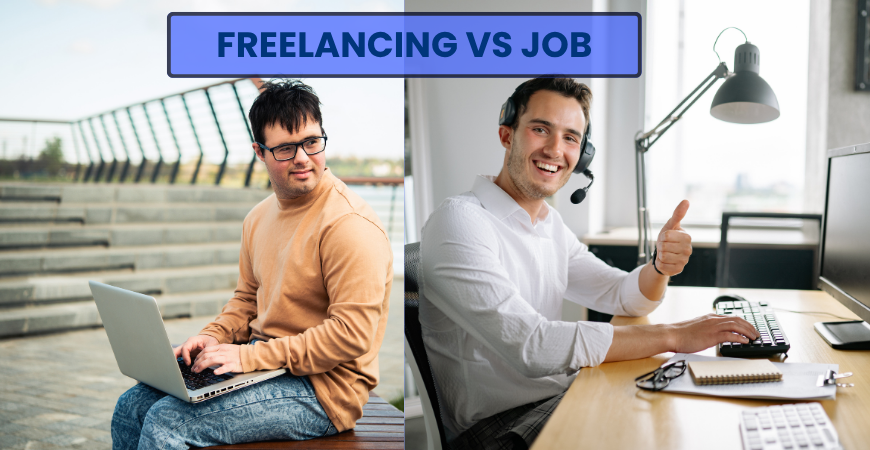
Choosing between freelancing vs job opportunities is an important career decision for digital marketers. A job can provide structured experience and regular income, while freelancing can offer greater control over clients, projects and working arrangements.
The better choice depends on more than salary or flexibility. Income stability, career growth, practical experience, client acquisition and the skills required to succeed all need to be considered.
Freelancing vs Job: The Real Differences That Matter
A full-time digital marketer works within an organization or agency, where the employer provides the role, work structure and business operations. Depending on the company, employees may also receive benefits such as paid leave, insurance or retirement contributions.
A freelancer has more independence but also more responsibility. Along with delivering marketing work, they may need to find clients, prepare proposals, negotiate prices, manage deadlines and follow up on payments.
| Factor | Full-Time Job | Freelancing |
| Income | More predictable | Variable |
| Job security | Generally higher | Depends on client pipeline |
| Flexibility | Depends on employer | Usually greater |
| Client choice | Limited | Greater control |
| Mentorship | Often available | Mostly self-directed |
| Benefits | May be provided | Usually self-managed |
| Career progression | More structured | Self-directed |
| Client acquisition | Employer handles it | Freelancer handles it |
| Business responsibility | Lower | Higher |
The biggest difference is where the responsibility sits. An employee mainly focuses on marketing work, while a freelancer must manage both marketing delivery and parts of running a business.
Freelancing vs Job: Which Pays More?
This is where simple comparisons can be misleading. Freelancers can work with several clients, but that does not mean every freelancer earns more than an employee with similar experience.
For full-time employment in India, AmbitionBox’s 2025 data for Digital Marketing Executives shows an annual salary range of ₹1.4 lakh to ₹5.5 lakh for employees with less than one to five years of experience. Actual compensation varies by experience, location, industry and employer.
Freelance income is harder to compare because professionals may charge hourly, per project or through monthly retainers. Upwork’s India marketplace data also shows substantial variation in digital marketing rates depending on expertise and profile.
A freelancer’s revenue isn’t the same as personal income. Time spent finding clients, preparing proposals, buying software, handling administration and dealing with gaps between projects can reduce effective earnings.
Job: greater income predictability.
Freelancing: potentially greater earning upside, but greater uncertainty and business responsibility.
Therefore, a higher freelance rate does not automatically mean higher annual income. The amount of billable work and recurring clients matters just as much.

Freelancing vs Job: Which Offers Better Career Growth?
A digital marketing job generally provides a clearer organizational progression:
Executive → Specialist/Senior → Manager → Strategist/Head
Employees can gain mentorship, team experience, exposure to larger campaigns and leadership opportunities. Understanding different digital marketing job roles can help beginners see how individual specializations fit into a longer career.
The wider digital marketing career path can also move from one specialization into strategy or management as experience grows.
Freelancing follows a different progression:
Beginner → Service Provider → Specialist → Retainer Freelancer → Consultant/Agency Owner
Instead of promotions, growth can come from specialization, increasing rates, gaining recurring clients and eventually building a consulting or agency model.
A job therefore offers more structured progression, while freelancing offers more control over the direction and scale of your career.
Freelancing vs Job: Which Gives More Freedom?
Freelancing generally provides greater control over:
- Working hours
- Location
- Client selection
- Project selection
- Pricing
- Workload
Employees usually have less control because company policies, team schedules and campaign deadlines influence their working arrangements.
However, freedom does not mean less work. A freelancer may finish a client project and then need to find the next client, send proposals, negotiate projects or follow up on payments.
A useful way to think about it is:
A job gives you less control but transfers more business responsibility to the employer. Freelancing gives you more control but transfers more business responsibility to you.
Which Is Better for Beginners in Digital Marketing?
For someone starting from zero, a full-time digital marketing job is often the lower-risk option. It can provide:
- Experience with real campaigns
- Guidance from experienced marketers
- Feedback on your work
- Team and client exposure
- Predictable income
- Professional experience for your resume
Freelancing is possible for beginners, but knowing digital marketing basics is not enough. You also need to answer:
- What service can I sell?
- What can I show prospective clients?
- How much should I charge?
- How will I find clients?
- How will I demonstrate results?
This is why a digital marketing portfolio and practical digital marketing projects can be valuable. They provide evidence that you can apply what you’ve learned rather than simply claiming knowledge.
For beginners, employment may make more sense if they need mentorship, experience and financial stability. Freelancing becomes more realistic once they can independently deliver work and attract clients.
What Skills Do You Need for a Digital Marketing Job or Freelancing?
The core technical skills are similar for both paths:
- SEO
- Google Ads
- Social media marketing
- Content marketing
- Email marketing
- Analytics and reporting
- Conversion tracking
You also need communication, problem-solving, data interpretation, time management and project-management skills.
Freelancers need additional business skills, including:
- Client acquisition
- Proposal writing
- Pricing
- Negotiation
- Personal branding
- Client retention
Strong digital marketing skills therefore involve more than learning individual tools. You need to understand how those tools support marketing objectives and how to turn your work into something a business can use.
For someone considering professional training, practical implementation matters. A useful course should provide opportunities to work with tools, complete projects and develop evidence of what you can do. Academy of Digital Marketing (ADM), for example, focuses on practical digital marketing learning alongside structured training. Learners considering a digital marketing course should evaluate whether the course’s projects, practical exposure and learning format match their career goals.
Freelancing vs Job: Which Should You Choose?
Choose a full-time job if you:
- Are new to digital marketing
- Need predictable income
- Want mentorship
- Want team experience
- Need to build a portfolio
Consider freelancing if you:
- Can independently deliver a marketable service
- Have practical work to show
- Can communicate with clients
- Understand pricing and project scope
- Can handle variable income
- Can consistently find clients
This last point is particularly important. Digital marketing freelancing isn’t simply about knowing SEO, advertising or social media. You also need a repeatable way to generate enquiries and turn suitable prospects into paying clients.
That is why freelance marketing skills such as personal branding, networking, proposals and client acquisition can become just as important as technical marketing ability once you work independently.
Consider both if you:
Already have a job and want to test freelancing gradually. First check your employment agreement and workplace policies regarding outside work and conflicts of interest.
For example, a fresher with practical training but no client experience may benefit from starting in a job, building skills and then taking selected freelance projects. An experienced SEO or PPC specialist with a strong portfolio and existing clients may be ready to freelance much sooner.
The right decision is therefore based on career readiness, not simply preference.
Frequently Asked Questions
Is freelancing better than a digital marketing job?
For most beginners, a digital marketing job can be a better starting point because it provides structured experience, mentorship and predictable income. Freelancing becomes more attractive after building practical skills, a portfolio and client-management experience.
Is freelancing more profitable than a digital marketing job?
It can be, but there is no guaranteed income advantage. Freelancers can work with multiple clients and increase their rates, but they also face client-acquisition costs, business expenses and periods without work.
Is a digital marketing job better for beginners?
Usually. Beginners can gain practical experience, feedback and exposure to real campaigns without having to manage client acquisition, pricing and every other part of running a freelance business.
Can I freelance while working a full-time digital marketing job?
It may be possible, but check your employment contract and company policies first. You also need to ensure freelance work does not interfere with your primary responsibilities or create conflicts of interest.
Freelancing vs job: Which should a digital marketer choose?
The better option depends on your experience, financial needs and preferred working style. A job may suit those seeking stability and structured growth, while freelancing may suit experienced marketers who value flexibility, independence and greater control over clients and projects.
Conclusion
The better choice in the freelancing vs job debate depends on your experience and career goals. For most beginners, a full-time digital marketing role offers structured learning, mentorship and stable income. Freelancing becomes more attractive once you can deliver results independently, show a strong portfolio and consistently find clients. Choose the path that matches your skills and long-term goals.

