
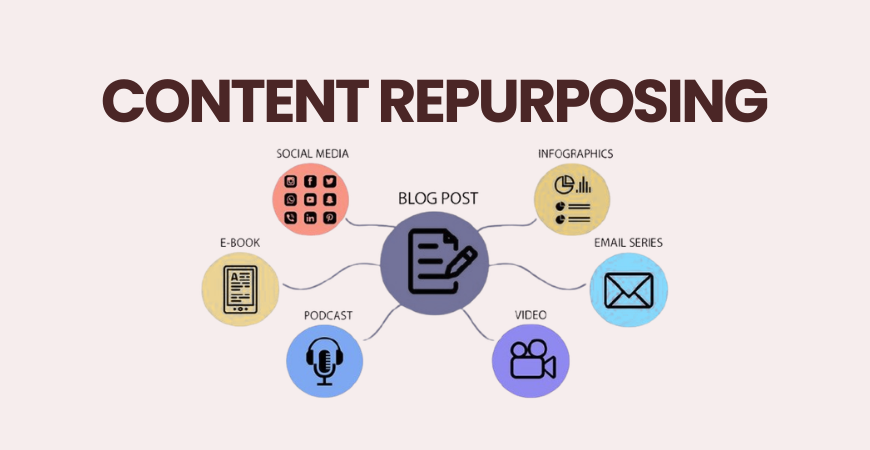
Content repurposing is the process of transforming existing content into new formats to reach different audiences, extend content lifespan, and maximize ROI. Instead of creating everything from scratch, businesses reuse blog posts, videos, and other assets by adapting them into social media posts, email newsletters, infographics, podcasts, and more. This approach improves efficiency, increases content reach, and helps maintain consistent publishing across multiple channels. When applied correctly, content repurposing allows marketers to scale output without increasing effort while improving overall performance across platforms.
Key Takeaways
- Content repurposing helps maximize the value of existing content assets.
- One piece of content can be transformed into multiple formats for different platforms.
- Repurposing improves content reach, lifespan, and marketing ROI.
- High-performing and evergreen content are ideal candidates for repurposing.
- A structured workflow ensures consistent and scalable content production.
Introduction
Modern content marketing demands continuous publishing across blogs, social media, email, and video platforms. Meeting this demand with entirely new content often leads to high workload and inconsistent output.
Content repurposing solves this by turning existing content into multiple formats tailored for different channels. This helps teams maintain consistency, improve efficiency, and scale content production without increasing resources.
What Is Content Repurposing?
It is the process of taking existing content and transforming it into different formats without changing its core message.
For example:
- A blog article becomes a LinkedIn post
- A webinar becomes multiple short-form videos
- A podcast becomes a blog article
- Research data becomes an infographic
- A case study becomes an email sequence
The goal is not to duplicate content but to adapt it for different platforms, audiences, and consumption preferences.
Content Repurposing vs Reposting
Many beginners confuse repurposing with reposting, but they are not the same.
| Content Repurposing | Reposting |
| Changes the format | Uses the same format |
| Adds new value | Minimal modification |
| Targets different platforms | Usually targets the same platform |
| Extends content lifespan | Limited impact |
| Improves content reach | Provides temporary visibility |
Repurposing focuses on adaptation, while reposting focuses on redistribution.
Why Repurposing of Content Matters
Content repurposing helps businesses achieve more results from every content asset they create.
According to multiple marketing industry studies, content teams using AI-assisted and structured workflows often reduce production time by 30–50% compared to entirely manual processes. This efficiency makes repurposing increasingly important in modern marketing environments.
Saves Time and Resources
Creating quality content requires:
- Research
- Planning
- Writing
- Editing
- Design
- Distribution
Repurposing allows creators to reuse existing knowledge and insights instead of repeating the entire process.
Extends Content Lifespan
Many content assets perform well for only a short period before becoming inactive.
Repurposing gives older content new life by presenting it in fresh formats.
A successful blog post from six months ago may still generate engagement when transformed into:
- Videos
- Social posts
- Email content
- Infographics
Improves Content Marketing ROI
Every piece of content requires an investment of time, effort, and resources.
Repurposing increases the return generated from that investment by creating multiple assets from a single source.
This is especially valuable for organizations operating under a structured content marketing plan, where maximizing efficiency is often a priority.
Reaches Different Audience Segments
People consume content differently.
Some prefer:
- Reading articles
- Watching videos
- Listening to podcasts
- Browsing social media
Repurposing allows the same information to reach audiences through their preferred formats.
Types of Content That Can Be Repurposed
Nearly every type of content asset can be repurposed.
Blog Posts
Blogs are often the easiest content format to repurpose.
A single article can become:
- Social media posts
- Infographics
- Email newsletters
- Video scripts
- Presentation slides
Videos
Videos contain multiple content opportunities.
A long-form video can be transformed into:
- YouTube Shorts
- Instagram Reels
- LinkedIn clips
- Blog articles
- Social snippets
Podcasts
Podcast episodes can become:
- Blog posts
- Quote graphics
- Social content
- Email newsletters
- Video clips
Webinars
Webinars often contain substantial educational content that can be divided into numerous smaller assets.
Case Studies
Case studies can be repurposed into:
- Success stories
- Social proof content
- Sales enablement materials
- Email campaigns
Real-World Content Repurposing Example
One of the easiest ways to understand content reuse is to see how a single content asset can be transformed into multiple formats.
Imagine a business publishes a 2,000-word blog article about social media marketing.
Instead of letting that content exist only as a blog post, it can be converted into:
| Original Asset | Repurposed Asset |
| Full Blog Article | LinkedIn Article |
| Key Statistics | Social Media Graphics |
| Step-by-Step Framework | Instagram Carousel |
| Major Insights | Email Newsletter |
| Key Takeaways | X (Twitter) Thread |
| Educational Sections | Short-Form Videos |
| Expert Quotes | Quote Graphics |
| Complete Guide | Presentation Slides |
This approach allows one content asset to generate weeks of promotional content across multiple channels while maintaining a consistent message.
How Content Repurposing Supports the Content Marketing Funnel
Repurposed content can strengthen every stage of the customer journey.
A well-structured content marketing funnel requires different types of content for different audience needs.
Top of Funnel (Awareness)
Content examples:
- Blog articles
- Social media posts
- Educational videos
Middle of Funnel (Consideration)
Content examples:
- Case studies
- Webinars
- Email sequences
Bottom of Funnel (Decision)
Content examples:
- Testimonials
- Product demonstrations
- Success stories
Repurposing allows businesses to create content for each stage without constantly producing entirely new material.
What Content Should You Repurpose First?
Not every piece of content deserves to be repurposed. The most effective content recycling strategies focus on content that has already demonstrated value or has long-term relevance.
A simple prioritization framework is:
| Content Type | Priority | Reason |
| Evergreen Guides | High | Long-term relevance and ongoing search demand |
| High-Traffic Posts | High | Proven audience interest and engagement |
| Lead-Generating Content | High | Direct business impact and conversion potential |
| Seasonal Content | Medium | Useful during specific periods of the year |
| News Content | Low | Becomes outdated quickly |
Before investing time in repurposing, review your analytics to identify content that consistently attracts traffic, engagement, or conversions. Starting with proven content often produces the strongest results.
A Step-by-Step Content Repurposing Workflow
Successful content recycling follows a structured process.
Step 1: Identify High-Performing Content
Start by identifying content that has already shown strong performance.
Key metrics include:
- Organic traffic
- Engagement
- Conversions
- Shares
- Time on page
Evergreen content is often the best candidate.
Step 2: Extract Core Insights
Identify:
- Main takeaways
- Statistics
- Quotes
- Frameworks
- Examples
These become the foundation for new content formats.
Step 3: Match Content to Channels
Different channels require different formats.
| Original Content | Repurposed Content |
| Blog Post | Social Posts |
| Webinar | Video Clips |
| Podcast | Article |
| Research Report | Infographic |
| Case Study | Email Sequence |
Step 4: Adapt the Format
Audience expectations vary from one platform to another.
For example:
- LinkedIn prefers professional insights
- Instagram favors visuals
- YouTube prioritizes video storytelling
- Email requires concise messaging
Step 5: Schedule Distribution
Effective social media content planning ensures repurposed assets are distributed consistently rather than all at once.
Step 6: Measure Results
Track:
- Engagement
- Click-through rates
- Traffic
- Leads
- Conversions
Data helps determine which repurposed formats perform best.
Best Content Formats for Repurposing
Certain content formats create more repurposing opportunities than others because they contain multiple insights, examples, and audience touchpoints.
Long-Form Blog Content
A single piece of high-quality blog content can generate weeks of promotional material. Long-form articles often contain statistics, frameworks, examples, and key takeaways that can be transformed into social posts, videos, newsletters, infographics, and presentation slides.
Educational Videos
Videos are among the most versatile content assets available. A single video can be repurposed into short-form clips, quote graphics, blog articles, social media posts, transcripts, and email content.
Podcasts
Podcast episodes contain valuable discussions, insights, and expert opinions that can be converted into articles, social snippets, newsletters, quote graphics, and video clips.
Research Reports
Research reports often contain original data and industry insights. These assets can be transformed into infographics, statistics-based social posts, presentations, articles, and downloadable resources that support broader marketing efforts.
The more comprehensive the original content asset, the greater its repurposing potential across different platforms and audience segments.
Tools That Simplify the Repurposing of Content
Technology has made content repurposing far easier than in the past.
Popular content creation tools include:
ChatGPT
Useful for:
- Summarization
- Content expansion
- Social media adaptation
- Idea generation
Canva
Useful for:
- Graphics
- Infographics
- Social media visuals
Descript
Useful for:
- Transcription
- Podcast editing
- Video editing
CapCut
Useful for:
- Short-form video creation
- Caption generation
- Social video editing
Notion
Useful for:
- Workflow management
- Content organization
- Editorial planning
Content Repurposing and SEO
Content reuse can support search visibility when implemented strategically.
Repurposing helps marketers expand topical coverage while reinforcing subject expertise.
For example, an article can be transformed into:
- FAQs
- Supporting articles
- Video content
- Social assets
This approach often complements broader SEO content creation efforts by increasing content depth around important topics.
Does Content Repurposing Create Duplicate Content?
No.
Duplicate content issues typically occur when identical content appears across multiple pages.
Repurposing involves transforming content into new formats rather than copying it directly.
Common Mistakes To Avoid
Many marketers make avoidable mistakes when implementing repurposing of content.
Repurposing Everything
Not every content asset deserves repurposing.
Focus on:
- Evergreen content
- High-performing content
- Strategic content
Ignoring Platform Differences
Different platforms attract audiences with different expectations.
A LinkedIn post should not look identical to an Instagram caption.
Failing to Update Information
Credibility can suffer when content contains outdated information.
Always verify:
- Statistics
- Examples
- References
- Industry changes
Prioritizing Quantity Over Quality
Repurposing should improve reach, not create content clutter.
Content Repurposing and Video Marketing
Video continues to be one of the most effective content formats available.
Research consistently shows that short-form video often generates significantly higher engagement than many static content formats.
A strong video content strategy often starts with existing content assets.
Examples include:
- Turning blogs into videos
- Creating clips from webinars
- Transforming podcasts into video snippets
This approach reduces production effort while maintaining a steady flow of video content.
Measuring the Success of Repurposing
Repurposing of content should contribute measurable business outcomes.
Key metrics include:
Traffic Metrics
- Organic traffic
- Referral traffic
- Page views
Engagement Metrics
- Likes
- Shares
- Comments
- Watch time
Conversion Metrics
- Leads
- Signups
- Sales
- Downloads
SEO Metrics
Repurposing often contributes indirectly to stronger content optimization efforts by increasing content exposure and engagement opportunities.
Organizations that track these metrics consistently can refine their repurposing strategies over time.
At institutions such as Academy of Digital Marketing (ADM), content workflow discussions often emphasize measurement because repurposing without performance analysis limits long-term improvement.
Content Repurposing and Topical Authority
Content reuse does more than save time. It can also strengthen topical authority.
When a business consistently expands valuable content into supporting formats and related topics, search engines gain stronger signals about its expertise.
For example, a single article about content marketing could be repurposed into:
- Social media content
- Video tutorials
- FAQ content
- Supporting blog posts
- Email campaigns
Over time, these interconnected assets help establish stronger subject coverage.
Research from multiple SEO industry studies suggests that websites with deeper topical coverage often achieve stronger organic visibility than websites publishing isolated content pieces. By expanding valuable content into multiple supporting assets, businesses can strengthen subject relevance while creating additional opportunities for audience engagement.
How Content Repurposing Supports Topical Authority
- Expands topic coverage
- Strengthens internal linking opportunities
- Reinforces entity relationships
- Creates multiple user touchpoints
- Supports long-term content growth
Rather than viewing repurposing only as a productivity tactic, marketers should also view it as a strategic method for building content depth and authority.
Repurposing of Content in the Age of AI
Artificial intelligence is changing how marketers approach content production.
AI tools can assist with:
- Summaries
- Content transformation
- Format adaptation
- Idea generation
- Workflow automation
Even so, human expertise continues to play a critical role.
AI can accelerate execution, but strategy, creativity, and audience understanding still require human involvement.
Many professionals exploring advanced content workflows through Academy of Digital Marketing (ADM) and similar educational environments increasingly learn how AI can complement, not replace, effective content marketing practices.

Frequently Asked Questions
1. What is content repurposing?
Content repurposing is the process of transforming existing content into new formats to reach different audiences, extend content lifespan, and improve content efficiency. It helps marketers get more value from existing assets by adapting them for multiple platforms instead of creating everything from scratch.
2. What content can be repurposed?
Blog posts, videos, podcasts, webinars, case studies, email newsletters, and research reports are all suitable for repurposing. Almost any high-value content can be adapted into different formats to increase reach and engagement.
3. Does content repurposing help SEO?
Yes. Content reuse can strengthen topic coverage, increase content visibility, support internal linking opportunities, and contribute to broader SEO strategies. It helps search engines understand deeper topical authority across multiple content formats.
4. Can content repurposing help small businesses with limited budgets?
Yes. Content repurposing allows small businesses to maximize the value of every content asset they create, reducing production costs while maintaining a consistent publishing schedule across multiple channels. This makes it a highly cost-effective content strategy.
5. What is the difference between repurposing and reposting?
Repurposing changes the format and presentation of content, while reposting simply republishes the same content with little or no modification. This distinction is important when planning long-term content strategies.
6. Which tools are best for content repurposing?
Popular options include ChatGPT, Canva, Descript, CapCut, and Notion because they simplify writing, design, transcription, editing, and workflow management. These tools make it easier to scale multi-format content production efficiently.
Conclusion
Content repurposing is one of the most effective ways to increase content output without significantly increasing workload. By transforming existing assets into new formats, businesses can extend content lifespan, improve reach, support SEO efforts, and strengthen audience engagement. It also helps maximize the return from every piece of content created.
The most successful approach is to start with high-quality content, identify opportunities for adaptation, and build a repeatable workflow around distribution and measurement. Whether you are a solo creator, marketer, or business owner, this approach helps you scale content efficiently while delivering consistent value across multiple channels.

